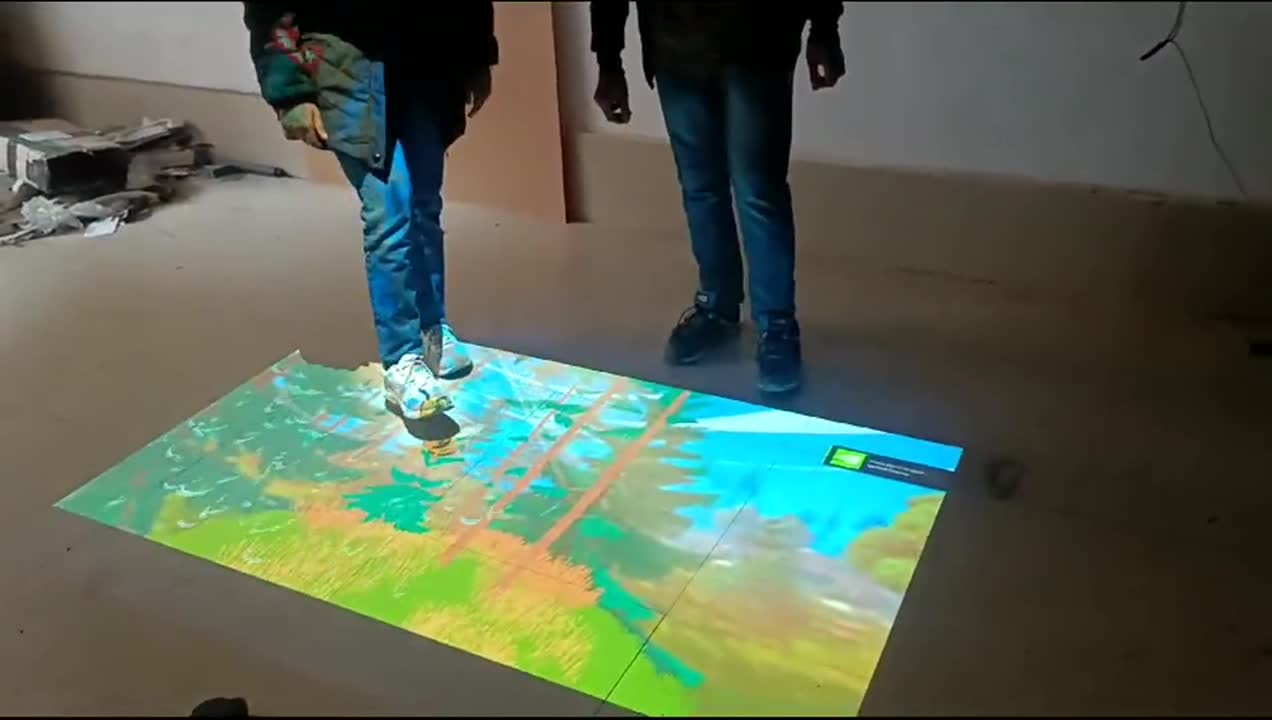
Motion-sensor games are exactly what they sound like: games you play with your body instead of a controller. A sensor reads your movement — a step, a swing, a wave, a jump — and the game responds on screen, floor, or wall. No joystick, no headset, nothing to hand out or break. That simplicity is the whole point: a passer-by becomes a player in seconds, with zero learning curve.
For venues, that low friction is why motion games consistently out-engage passive screens. People don't watch them — they play them, film them, and queue for them.
How motion games work
The setup is a display (screen, or a projector for floor/wall), a motion/depth sensor that tracks the player's position and gestures, and software that maps movement to gameplay. Because the player is the controller, motion games are inherently inclusive — children, adults, and groups all play the same way, and there's nothing to teach.
They take a few common forms: - Projected floor games — react to footsteps (best for crowds and active play). - Projected wall games — react to touch, throw, or gesture. - Camera/screen motion games — the player's body controls an on-screen game.
(For the projection formats specifically, see our guide to interactive projection screens.)
Why venues install them
- Engagement through movement — active play holds attention far longer than a screen to watch.
- Crowd-forming — a queue is social proof; people join in.
- Shareable — watching yourself or your kids control a game is filmable, so visitors market your venue for free.
- Low maintenance — no controllers to lose, no consoles in public hands; the "device" is the room.
- One platform, many games — swap content for seasons, campaigns, or audiences without new hardware.
Where they fit
Malls and play zones (crowd-formers), schools and early-years (active learning), restaurants and cafés (kids' corners), gyms and active-play centres, brand activations and events, and family entertainment centres. Anywhere footfall needs to stop, engage, and stay.
Custom motion games for your brand or venue
Off-the-shelf motion games are fixed; custom ones aren't. Because Bamigos.com builds the games and software in-house, a motion game can be themed to your brand, your campaign, or — for schools — your curriculum, with custom characters, scoring, and prizes. (More on custom games for events, expos & activations.)
Pricing depends on the format and how much custom content you want, so we scope each setup to the venue and goal.
Frequently asked questions
Do motion-sensor games need controllers or headsets?
Planning a Gaming Zone?
Get expert recommendations and pricing for your venue: including the Pikcha AI photo booth, a self-service photo attraction to evaluate for your venue. No obligation.
No — the player's body is the controller. A sensor reads movement and the game responds, so anyone can play instantly with nothing to hand out.
What ages can play?
All ages — because there's nothing to learn or hold, children, adults, and groups all play the same way.
Where do motion games work best?
Malls, schools, restaurants, gyms, FECs, and brand activations — anywhere footfall needs to stop, engage, and stay.
Can the games be branded or customised?
Yes — built in-house, they can carry your characters, scoring, prizes, or (for schools) curriculum.
Bring no-controller, full-body play to your venue
Motion-sensor games on floor, wall, or screen — built and supported in India.
Talk to Us