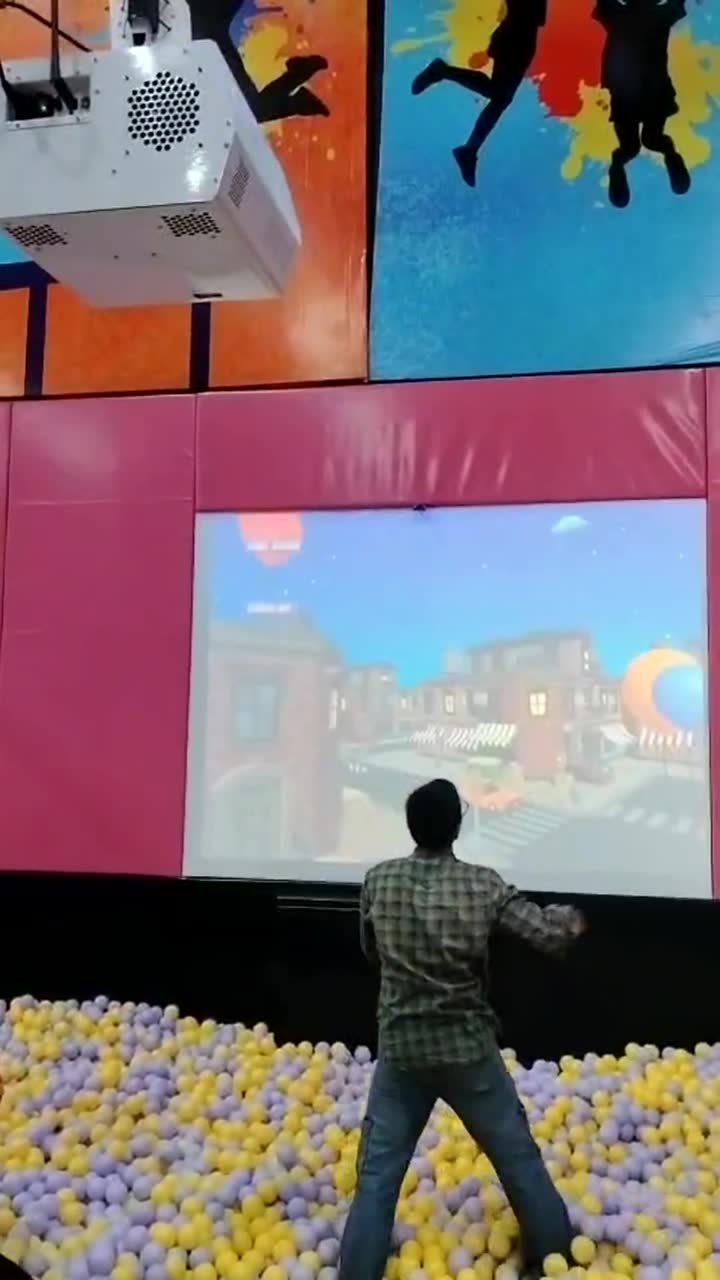
Most venues have a blank wall doing nothing. Interactive wall projection turns it into an attraction — a vertical surface where people throw, touch, swipe, and gesture to control a game. It's the wall-mounted sibling of interactive floor projection: same idea, different surface, and a different set of jobs it does best.
Wall vs floor — which to choose
Both react to movement; they suit different goals:
- Wall projection is for reach-and-touch play — target-throwing, sorting, drawing, whack-style and climbing-style challenges. It excels where floor space is tight, and it turns dead vertical space into a draw.
- Floor projection is for step-and-move play — kicking, dodging, splashing — and forms bigger crowds in open areas.
Many venues run both: a floor game to form the crowd, a wall game to hold the overflow. (See the format breakdown in our interactive projection screens guide.)
How wall projection works
A projector casts the game onto the wall; a motion sensor reads where hands or thrown objects hit; software responds instantly. No touchscreen hardware on the wall itself, so there's nothing fragile at hand height — the surface stays a plain wall when the system is off.
Where it pays off
- Play zones & FECs — active wall games that complement paid attractions.
- Schools — reach-and-touch learning games (matching, spelling, sorting) for early years.
- Restaurants & cafés — a small wall game in a corner keeps children busy and tables turning.
- Malls — turn a dead-end corridor or feature wall into a footfall draw.
- Brand activations & events — a branded throw-the-logo or target game as the centrepiece.
What to look for
- A clean, suitably sized wall surface and the right throw distance for the projector.
- Brightness matched to ambient light.
- A content library plus custom-game capability — branded, seasonal, or curriculum-specific games keep it fresh.
- Company-backed support and parts so downtime doesn't kill the attraction.
Custom and supported in India
Bamigos.com designs the wall games, the software, and the systems in-house in New Delhi — so you get content built for your venue and the option of fully custom, branded games, with support behind it rather than an imported unit no one can service. Pricing is scoped to wall size, brightness, and the games you want.
Frequently asked questions
Wall or floor projection — which should I choose?
Interested in Interactive Projection?
Get pricing and specs for interactive floor & wall projection systems.
Wall is best for reach-and-touch games and tight spaces; floor is best for step-and-move games and forming crowds in open areas. Many venues use both.
What kind of wall do I need?
A clean, suitably sized vertical surface with the right projector throw distance; we scope it to your wall and lighting.
Is anything mounted on the wall at hand height?
No — there's no touchscreen hardware on the wall; the surface stays a plain wall when the system is off, so nothing is fragile or exposed.
Can wall games be custom or branded?
Yes — content can be themed to your brand, season, or curriculum.
Turn your blank wall into a game
Interactive wall projection — built, customised, and supported in India.
Get a Wall-Projection Quote