Interactive floor projection is transforming how Indian venues—from shopping malls to schools to family entertainment centers—engage their visitors. This comprehensive guide covers everything you need to know about this technology: how it works, where it's used, why it's becoming essential for modern venues, and how to choose the right system for your needs.
Related: Augmented reality games for events — how AR floor & wall games pull crowds at malls, expos, and activations.
Interactive projection by use case: for schools · for malls · for restaurants & cafés.
Interactive projection — explore: projection screens (floor/wall/table) · interactive wall games · motion-sensor games · TouchMagix vs Bamigos.
What is Interactive Floor Projection?
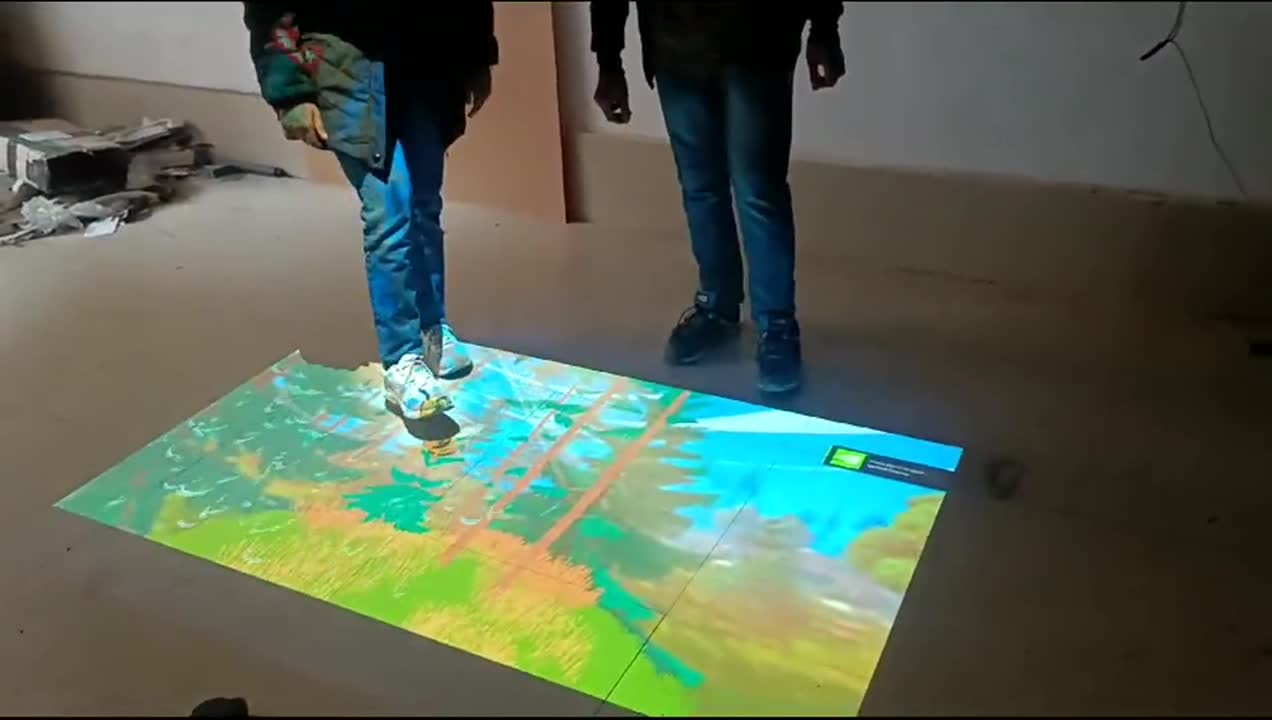
Interactive floor projection is an immersive display technology that projects dynamic visuals onto a floor surface and responds in real-time to human movement. Unlike static graphics or pre-rendered projection mapping, these systems are motion-aware—when someone steps, jumps, or gestures on the projected surface, the system detects it and instantly alters the visuals.
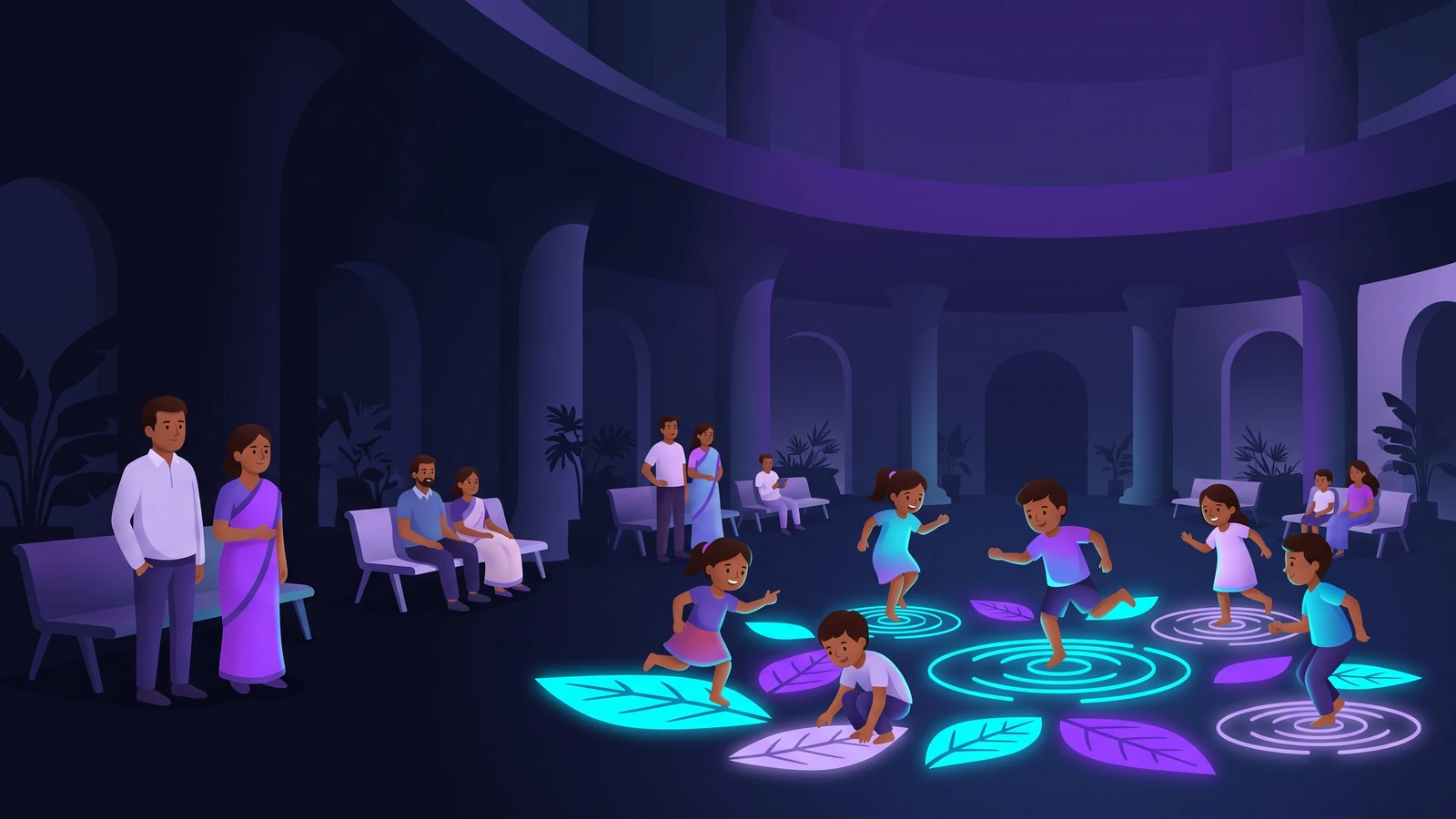
Imagine walking into a mall atrium and seeing a projected pond on the floor. As you step into it, fish scatter and swim away from your feet. Ripples spread outward from where you walk. A child jumps, and the water splashes. That's interactive floor projection in action.
The technology combines:
- High-brightness projectors that cast images onto floors
- Motion sensors (infrared cameras, depth sensors, or LiDAR) that track movement
- Specialized software that processes motion data and renders real-time graphics
- A library of games and effects designed specifically for floor-based interaction
The result is a floor that behaves more like a giant touchscreen—only instead of touching with fingers, visitors interact with their entire bodies. No controllers, no wearables, no learning curve. Anyone can step in and start playing immediately.
How Interactive Floor Projection Works: The Technology Explained
Every interactive floor projection system consists of five core components working together:
1. The Projector
A high-brightness projector, typically mounted on the ceiling, casts images downward onto the floor. For commercial installations in India, you'll typically need:
- Brightness: 3,000–6,000 ANSI lumens for indoor venues; 6,000+ lumens for brightly lit spaces like mall atriums
- Resolution: 1920×1080 (Full HD) minimum; some systems support 4K
- Throw ratio: Short-throw or ultra-short-throw projectors work best for wall installations; standard throw for floor projections
2. The Motion Sensor
Sensors detect users and their movements in real-time. Common approaches include:
- Infrared (IR) cameras: Detect body heat and movement; less expensive, works in varied lighting
- Depth sensors: Create a 3D depth map of the space (like Microsoft Kinect or Intel RealSense technology)
- LiDAR sensors: Use laser scanning for precise position tracking; more expensive but highly accurate
- Pressure-sensitive mats: Detect footsteps through physical pressure; less common in modern systems
Camera-based systems are most common for interactive games because they can detect full-body movement, not just feet.
3. The Computer/Processing Unit
A dedicated computer processes sensor data and renders graphics in real-time. Modern systems often use:
- Integrated solutions: All-in-one units with projector, sensor, and computer combined
- Separate PC: Standard computer running the software, connected to projector and sensors
- Industrial PCs: Ruggedized computers designed for 24/7 commercial operation
4. The Software
Software is what brings the system to life. It handles:
- Processing sensor data to track player positions and movements
- Rendering real-time graphics that respond to that movement
- Managing the game library and content selection
- Providing operator controls for brightness, volume, and game settings
The quality and variety of the software—particularly the game library—is often what differentiates one system from another.
5. The Surface
The projection surface affects image quality significantly:
- Best: Light-colored, smooth, non-reflective floors (white or light gray vinyl, laminate)
- Good: Standard mall tiles, light wood, concrete
- Challenging: Dark floors, carpets, highly reflective surfaces
For dark or carpeted venues, a large white projection mat can be placed to improve image quality.
The Processing Pipeline: From Movement to Visual Response
Here's what happens in the milliseconds between a player moving and the visuals responding:
- Motion Detection: Sensors continuously scan the projection area, detecting any movement—footsteps, jumps, hand waves, or body positions.
- Data Processing: The software interprets this sensor data, determining exactly where people are standing and how they're moving.
- Content Rendering: Based on the movement data and the active game, the system renders new graphics in real-time—making fish swim away, spawning new game elements, updating scores.
- Projection: The updated visuals are immediately projected onto the floor, creating the seamless interactive experience.
This entire cycle happens dozens of times per second, which is why the interaction feels instantaneous to players.
Why Interactive Floor Projection is Booming in India
India's indoor entertainment market is experiencing explosive growth, and interactive projection is at the center of it.
The Market Opportunity
- India's indoor amusement market is projected to reach ₹9,218 crore by 2030, nearly doubling from current levels
- The global FEC market is expected to grow from USD 34.4 billion (2025) to USD 93.5 billion by 2035
- Over 150 new FEC projects are planned across India through 2026, particularly targeting Tier-2 and Tier-3 cities
- India's middle class is expected to grow from 50 million to 583 million by 2025, driving demand for family entertainment
Why Venues Are Adopting This Technology
Interactive floor projection offers advantages that traditional entertainment can't match:
1. Touchless Engagement
In a post-pandemic world, touchless interaction has become a significant selling point. Interactive floors don't require visitors to touch any surfaces, buttons, or shared controllers—reducing hygiene concerns that parents particularly value.
2. Universal Accessibility
Anyone can play—toddlers, children, teens, adults, even grandparents. There's no learning curve, no controller to figure out, no instructions to read. You just step onto the projection and start interacting.
3. High Visibility and Foot Traffic
A floor with fish swimming around or games being played is impossible to ignore. Interactive projections draw crowds of spectators and drive footfall to surrounding areas—which is why malls love placing them near retail zones.
4. Social Media Content
Interactive floor projections are inherently "Instagrammable." Parents film their children playing, visitors share videos of themselves interacting with creative effects. This organic social media content is valuable marketing that venues get for free.
5. Operational Simplicity
Unlike mechanical rides or complex arcade machines:
- No moving parts means minimal maintenance
- No tickets or tokens to manage (players just step in)
- No operator required for basic functionality
- Content can be updated remotely without hardware changes
Where Interactive Floor Projection is Used in India
Interactive floor projection has found applications across virtually every venue type that serves families, children, or seeks to create memorable experiences.
Shopping Malls
Malls across India are installing interactive floors in:
- Kids zones and play areas: Dedicated spaces where children can play while parents shop or dine nearby
- Atriums and common areas: High-visibility installations that draw crowds and increase dwell time
- Near food courts: Entertainment for children while families eat
- Event spaces: Temporary installations for festive seasons, brand activations, or promotional events
For malls, the key benefit is increased footfall and dwell time—families stay longer when children are entertained.
Family Entertainment Centers (FECs) and Arcades
Interactive projection has become a standard attraction in modern FECs:
- Dedicated projection zones: Areas where groups can play projection-based games together
- Party room enhancements: Adding interactive elements to birthday party spaces
- Waiting areas: Keeping guests entertained while queuing for other attractions
- Toddler zones: Age-appropriate games for the youngest visitors
FECs particularly value the multiplayer aspect—projection games can accommodate multiple players simultaneously, unlike single-player arcade cabinets.
Schools and Educational Institutions
Indian schools are increasingly adopting interactive projection for:
- Early childhood education: Kinesthetic learning through movement-based games
- Physical education: Active games that combine exercise with entertainment
- Special needs education: Sensory-friendly content for children with autism or developmental needs
- Break time entertainment: Giving students an engaging activity during recess
Studies show that multi-sensory, movement-based learning can increase knowledge retention by up to 40% compared to traditional methods.
Hospitals and Healthcare
Healthcare facilities are using interactive projections to:
- Pediatric waiting areas: Distract and calm anxious children before appointments
- Rehabilitation therapy: Make physical therapy exercises more engaging
- Sensory rooms: Create calming, controllable environments for patients with sensory processing needs
- Long-term care facilities: Provide stimulation and entertainment for elderly patients
The touchless nature is particularly valuable in healthcare settings where hygiene is paramount.
Hotels and Resorts
Hospitality venues use interactive floors for:
- Kids clubs: Keeping young guests entertained while parents enjoy resort amenities
- Lobby entertainment: Creating memorable first impressions
- Event spaces: Adding interactive elements to weddings, conferences, and parties
- Restaurant waiting areas: Reducing perceived wait times
Restaurants and Cafés
Family-friendly dining establishments install interactive projections to:
- Create a unique dining experience that differentiates them from competitors
- Keep children occupied while food is prepared
- Drive repeat visits ("Let's go back to the restaurant with the floor games!")
- Generate social media content and word-of-mouth marketing
Museums and Science Centers
Educational venues use interactive floors for:
- Interactive exhibits: Bringing historical events or scientific concepts to life
- Wayfinding: Guiding visitors through galleries using floor-based navigation
- Engagement zones: Active areas where visitors can take a break from passive exhibits
Corporate and Events
The business sector uses interactive projections for:
- Trade shows and exhibitions: Drawing visitors to booths with interactive experiences
- Brand activations: Creating memorable branded interactions
- Corporate events: Team-building activities and entertainment
- Product launches: Interactive experiences tied to product themes
Types of Interactive Floor Projection Games
Interactive floor systems typically include libraries of games and effects across several categories:
Active Games
Games that require physical movement and quick reactions:
- Stomp games: Players stomp on targets (bugs, aliens, falling objects) before they disappear
- Chase games: Players chase projected characters across the floor
- Avoidance games: Players must avoid stepping on certain elements
- Collection games: Players collect items by stepping on them
Examples include Bakery Pop (collect desserts), Cosmic Capers (stomp aliens), and Buzz Buster (squash mosquitoes).
Sports and Fitness Games
Games that simulate physical activities:
- Virtual soccer or football
- Dance and rhythm games
- Racing games where running in place moves your character
- Fitness challenges with movement tracking
Creative and Artistic Effects
Non-game visuals that respond to movement:
- Water and ripple effects: Realistic water that splashes and ripples around players
- Nature scenes: Leaves that blow away, flowers that bloom where you step
- Particle effects: Stars, sparkles, or colorful trails following movement
- Interactive landscapes: Environments that transform based on player actions
Educational Content
Games designed for learning:
- Number and letter recognition games
- Matching and memory games
- Geography and map-based activities
- Science simulations
Sensory and Therapeutic Content
Specialized content for healthcare and special needs:
- Calming, slow-moving visuals for sensory rooms
- Cause-and-effect games for developmental therapy
- Customizable brightness and complexity levels
Key Benefits of Interactive Floor Projection
Interactive floor projection offers measurable benefits across multiple dimensions:
For Visitors and Players
- Immediate engagement: No learning curve—anyone can participate instantly
- Physical activity: Games encourage movement, jumping, and active play
- Social interaction: Multiplayer games bring people together
- Inclusive experience: Accessible to all ages and ability levels
For Venue Operators
- Increased dwell time: Visitors stay longer when engaged with interactive content
- Higher footfall: Visible installations attract attention and draw crowds
- Footfall driver: As a free-play crowd-puller, interactive zones pull visitors in and increase the spend at your paid attractions, food, and retail
- Lower operational costs: No moving parts, minimal staffing requirements
- Content flexibility: Games can be updated remotely without hardware changes
- Seasonal customization: Content can be themed for holidays, events, or promotions
Measurable Business Impact
Research and operator reports indicate:
- Dwell time increases: Visitors spend more time in areas with interactive projections
- Higher per-visitor revenue: Extended visits lead to more food, retail, and activity spending
- Strong social amplification: Interactive installations generate significant user-generated social media content
- Repeat visits: Regularly updated content drives return visits
Business Impact
Interactive floor projection is a free-play attraction — it usually has no per-session charge of its own. Instead, it works as a footfall magnet that lifts the rest of the venue:
- Longer dwell time: Visitors stay longer when there is something engaging to play with
- Higher footfall: A visible, eye-catching zone draws crowds toward your paid attractions
- More spend at paid attractions: Extra dwell time converts into more food, retail, and activity spending elsewhere in the venue
Interactive Floor Projection vs. Interactive Wall Projection
Many venues consider both floor and wall projection. Here's how they compare:
| Factor | Floor Projection | Wall Projection |
|---|---|---|
| Player position | Players stand on the projection | Players stand facing the wall |
| Physical activity | High (jumping, running, stomping) | Moderate (arm movements, reaching) |
| Space required | Open floor area | Clear space in front of wall |
| Visibility to passersby | Very high (games visible from above) | High (visible from sides) |
| Age suitability | All ages (toddlers love floor games) | Better for older children (need to reach) |
| Multiplayer capacity | High (many players at once) | Moderate (limited by wall width) |
| Shadow interference | Minimal (projection from above) | Possible (players can block projection) |
| Installation | Ceiling-mounted, needs height | Can be rear-projected or ceiling-mounted |
Many venues install both—floor projection for high-energy group play, wall projection for ball games and targeted interactions. Some systems, like those from Bamigos, offer both floor and wall options that can share a game library.
Interested in Interactive Projection?
Get pricing and specs for interactive floor & wall projection systems.
Installation Requirements for India
Planning an interactive floor projection installation in India? Here's what you need to consider:
Space Requirements
- Minimum floor area: Approximately 2.7m × 2m (9' × 7') of clear space
- Recommended for group play: 3m × 4m or larger
- Ceiling height: Minimum 2.4m (8 feet); 3–3.5m (10–12 feet) is optimal
- For large installations: Multi-projector setups can cover areas of 5m × 3m or larger
Electrical Requirements
- Standard 230V power supply
- Dedicated circuit recommended for commercial installations
- UPS backup advisable to prevent sudden shutdowns
Ambient Lighting
- Best results in controlled lighting environments
- Avoid direct sunlight or spotlights on the projection area
- Higher-lumen projectors can work in brighter spaces (5,000+ lumens for mall atriums)
Surface Considerations
- Light-colored, smooth floors work best
- If your floor is dark or carpeted, use a white projection mat
- Non-reflective surfaces prevent glare
Network and Connectivity
- Internet connection for software updates and remote support
- Local network for multi-unit installations
How to Choose an Interactive Floor Projection System
With several providers in the Indian market, here's what to evaluate:
1. Game Library and Content Quality
The games are what visitors actually experience. Consider:
- How many games are included?
- Are games age-appropriate for your audience?
- Is new content added regularly?
- Can content be customized or branded?
- Is the content developed specifically for floor projection, or adapted from other platforms?
2. Hardware Quality and Durability
Commercial installations run continuously. Evaluate:
- Projector brightness and lifespan
- Sensor reliability and accuracy
- Component quality for 24/7 operation
- Heat management and ventilation
3. Ease of Operation
Your staff will use this daily. Check:
- Is the interface intuitive?
- How easy is it to switch games or adjust settings?
- Can it run unattended once set up?
- What training is provided?
4. Installation and Support
Critical for commercial success:
- Is installation included?
- What warranty is offered?
- What's the response time for technical support?
- Is remote troubleshooting available?
- Are spare parts readily available in India?
5. Scalability
Consider future needs:
- Can you add more projectors to expand the play area?
- Does the software support multiple installations?
- Can wall projection be added later?
6. Made in India Advantages
Sourcing from Indian manufacturers offers benefits:
- Lower costs without import duties
- Faster delivery and installation
- Local support and faster response times
- Easier access to spare parts
- Support for the local economy
Interactive Floor Projection Providers in India
The Indian market has several providers offering interactive projection solutions:
Bamigos (Made in India)
Bamigos offers Wacky Floor, an interactive floor projection system manufactured in India with locally sourced components. Key features include:
- Multiple motion-sensing games including Bakery Pop, Pond Hopper, Cosmic Capers, and more
- Multiplayer support for group play
- Regular game updates
- Pan-India installation and support
- Made in India pricing advantage
Bamigos also offers Wacky Wall for interactive wall projection, allowing venues to implement both floor and wall solutions.
TouchMagix (Pune)
TouchMagix offers MotionMagix, a gesture-tracking platform for interactive walls and floors. They've been in the market for over a decade and serve both Indian and international clients.
FX Game Zone (International)
FX Game Zone offers systems with over 160 games and 1080p projection. They focus on educational institutions and healthcare facilities.
Other Options
International providers like LUMOplay (software-only), EyeClick, and various Chinese manufacturers also serve the Indian market, though with varying levels of local support.
Common Questions About Interactive Floor Projection
How much does interactive floor projection cost in India?
Pricing varies based on specifications, installation requirements, and provider. Factors affecting cost include projector brightness, projection size, game library, and installation complexity. For accurate pricing tailored to your venue, we recommend requesting quotes from providers and comparing total cost of ownership including installation, warranty, and ongoing support.
Is interactive floor projection safe for children?
Yes. Interactive floor projection is extremely safe because:
- There are no moving mechanical parts
- No physical contact with equipment (it's all projection)
- Players interact using natural movements they already make
- Touchless interaction means no shared surfaces
That said, ensure the play area is clear of obstacles and has appropriate supervision for young children.
How durable is the system for commercial use?
Quality commercial systems are designed for continuous operation:
- Projectors typically have lamp lives of 20,000+ hours (LED/laser) or 5,000+ hours (traditional lamps)
- Since interaction is touchless, there's no physical wear and tear on equipment
- Components are typically ceiling-mounted, away from player contact
- Systems are designed for 24/7 operation in commercial venues
Can the system work in bright environments like mall atriums?
Yes, but it requires higher-brightness projectors. For mall atriums or spaces with significant ambient light, you'll need projectors with 5,000+ ANSI lumens. Brighter spaces may also benefit from controlling nearby lighting sources.
How often does content need to be updated?
Content updates are optional but recommended to maintain visitor interest. Good providers release new games periodically, and many systems allow remote content updates without on-site visits.
Can the games be customized with our branding?
Many systems offer customization options, from simple logo placement to fully branded games for corporate events or brand activations. This is typically offered as an additional service.
What maintenance is required?
Maintenance requirements are minimal:
- Regular projector lens cleaning
- Occasional software updates
- Projector lamp replacement (varies by type)
- Sensor calibration if accuracy drifts
Most quality systems are designed for low-maintenance commercial operation.
Getting Started with Interactive Floor Projection
If you're considering interactive floor projection for your venue in India, here's a practical path forward:
Step 1: Define Your Requirements
- What type of venue? (Mall, FEC, school, hospital, etc.)
- What's your target audience? (Children, families, corporate visitors)
- How much space is available?
- What's your ceiling height?
- What are your lighting conditions?
Step 2: Research and Compare
- Request quotes from multiple providers
- Ask for demos or visit existing installations
- Compare game libraries and content quality
- Evaluate support and warranty terms
- Consider total cost of ownership, not just upfront price
Step 3: Plan the Installation
- Conduct a site survey with the provider
- Confirm electrical and structural requirements
- Plan for appropriate lighting control
- Schedule installation during low-traffic periods
Step 4: Train Your Team
- Ensure staff know basic operation
- Establish cleaning and maintenance routines
- Set protocols for addressing technical issues
Step 5: Launch and Promote
- Plan a launch event or soft opening
- Train staff to encourage visitor engagement
- Capture content for social media promotion
- Gather visitor feedback for future improvements
The Future of Interactive Floor Projection in India
Interactive floor projection technology continues to evolve:
- AI integration: Systems that adapt difficulty based on player behavior
- Improved sensors: More accurate tracking with faster response times
- Higher resolution: 4K and beyond for sharper visuals
- Augmented reality integration: Blending projected content with AR experiences
- Social features: Built-in sharing to social media platforms
- Data analytics: Tracking engagement metrics for venue optimization
As the technology matures and costs decrease, we expect interactive floor projection to become a standard feature in malls, schools, and entertainment venues across India—not a novelty, but a baseline expectation for modern family-friendly spaces.
Conclusion
Interactive floor projection represents a convergence of entertainment, technology, and practical business benefits. For Indian venues looking to increase engagement, dwell time, and visitor satisfaction, it offers a compelling solution that:
- Works for all ages without any learning curve
- Requires minimal maintenance and staffing
- Creates memorable, shareable experiences
- Delivers measurable business returns
Whether you're operating a mall play zone, building a new FEC, enhancing a school, or creating a therapy room, interactive floor projection has proven applications across India's diverse venues.
The question isn't whether this technology will become standard—it's whether your venue will be an early adopter capturing the benefits, or a latecomer trying to catch up.
Ready to Explore Interactive Floor Projection?
Learn more about Wacky Floor, Bamigos' made-in-India interactive floor projection system. Or contact us for a customized consultation based on your venue requirements.
Frequently Asked Questions
What is interactive floor projection?
Interactive floor projection is a technology that uses ceiling-mounted projectors and motion sensors to create dynamic visuals on floors that respond in real-time to human movement. When people walk, jump, or gesture on the projected surface, the images react—fish swim away, games activate, and effects respond to every movement.
How much space do I need for interactive floor projection?
The minimum space required is approximately 2.7m × 2m (9' × 7') of clear floor area with a ceiling height of at least 2.4m (8 feet). For optimal group play, 3m × 4m or larger is recommended. Larger installations can use multiple projectors to cover bigger areas.
Is interactive floor projection suitable for commercial venues in India?
Yes. Interactive floor projection systems are specifically designed for commercial use in malls, FECs, schools, hospitals, and other high-traffic venues. Quality systems are built for 24/7 operation with minimal maintenance requirements.
What venues use interactive floor projection in India?
Interactive floor projection is used across shopping malls (kids zones, atriums), family entertainment centers, schools and educational institutions, hospitals and healthcare facilities, hotels and resorts, restaurants, museums, and corporate event spaces.
How does interactive floor projection benefit my business?
Benefits include increased visitor dwell time and higher footfall to the surrounding area. As a free-play crowd-puller, it draws people in and lifts spending at your paid attractions, food, and retail, while keeping operational costs low compared to mechanical attractions and generating significant social media content through visitor sharing.
How does interactive floor projection pay off?
Interactive floor projection is a free-play attraction, so it usually has no per-session revenue of its own. Its value comes from footfall and dwell time — it draws crowds and keeps them in the venue longer, which lifts spending at your paid attractions, food, and retail.
Are there Indian manufacturers of interactive floor projection systems?
Yes. Companies like Bamigos manufacture interactive floor projection systems in India with locally sourced components. Made-in-India systems offer advantages including lower costs (no import duties), faster installation and support, and easier access to spare parts and service.
How do I choose between floor projection and wall projection?
Floor projection is better for high-energy group play, younger children, and maximum visibility. Wall projection works well for ball games and targeted interactions. Many venues install both—floor projection for group activities and wall projection for sports-style games.
![How to Start a Photo Booth Business in India: Complete Guide [2026]](/uploads/how-to-start-photo-booth-business-india.webp)