The photo booth industry in India is at an inflection point. Traditional DSLR-based setups have served event operators well for over a decade, but AI-powered photo booths are rewriting the rules — offering unmanned operation, real-time creative effects, and revenue models that were not possible five years ago.
India's photo booth market was valued at USD 26.9 million in 2024 and is projected to reach USD 56 million by 2033, growing at an 8.5% CAGR. Whether you are launching a new business, expanding an existing event services company, or investing in a permanent installation at a mall or tourist attraction, the choice between traditional and AI comes down to your business model, budget, and target audience.
This guide breaks down both options with real costs, revenue projections, and practical recommendations for the Indian market.
How a Traditional DSLR Photo Booth Works
A traditional photo booth is built around a DSLR camera connected to a laptop running photo booth software. The core workflow is straightforward:
- Camera setup — a DSLR (such as a Canon EOS 90D or Nikon D7500) with a prime or zoom lens, mounted on a tripod or enclosed in a booth housing
- Tethered shooting — the camera connects via USB to a laptop running dedicated photo booth software (dslrBooth, Darkroom Booth, or similar)
- Lighting — continuous LED panels or studio strobes for consistent exposure
- Printing — a dye-sublimation printer (Canon SELPHY for budget setups, DNP DS620A for professional operations) produces prints in 15-30 seconds
- Delivery — guests receive physical prints, sometimes with optional digital sharing via email or SMS
The operator typically manages the session — triggering the camera, adjusting settings, swapping props, and ensuring print quality. Some software packages allow touchscreen self-service, but most traditional setups benefit from a trained attendant.
Traditional DSLR Photo Booth: Setup Costs
Costs vary significantly depending on whether you are building a budget starter kit or a professional-grade setup.
Component-by-Component Breakdown
DSLR camera body₹35,000 – ₹55,000₹80,000 – ₹1,50,000 Lens (50mm f/1.8 or 24-70mm)₹10,000 – ₹15,000₹15,000 – ₹25,000 Laptop (tethering + software)₹40,000 – ₹50,000₹55,000 – ₹75,000 Printer₹10,000 – ₹12,000 (Canon SELPHY)₹45,000 – ₹60,000 (DNP DS620A) Photo booth software license₹8,000 – ₹15,000₹20,000 – ₹40,000 Lighting (LED panels)₹3,000 – ₹6,000₹8,000 – ₹15,000 Backdrop + stand₹3,000 – ₹5,000₹5,000 – ₹8,000 Props and accessories₹1,000 – ₹2,000₹2,000 – ₹3,000Total Setup Cost Tiers
Budget starter₹1,20,000 – ₹1,70,000Testing the market, small events Mid-range₹1,80,000 – ₹2,50,000Regular event rentals, weddings Professional₹3,00,000 – ₹4,50,000High-end events, corporate activationsRunning costs depend on your print volume and paper choice. Ask us for the numbers for your venue.
Pros of Traditional DSLR Photo Booths
- Lower initial investment — you can start a functional setup from ₹3.5 lakh, making it accessible for first-time entrepreneurs
- Superior raw image quality — large APS-C or full-frame sensors with interchangeable lenses produce images that AI processing cannot fully replicate
- No internet dependency — the entire system works offline, which matters for outdoor events, farmhouses, and remote wedding venues
- Proven technology — DSLR photo booths have been operating for 15+ years globally; the hardware is reliable and well-understood
- Familiar to operators — anyone with basic photography knowledge can set up and run a DSLR booth
- Client trust — many event planners and wedding coordinators are familiar with DSLR booths and trust the output quality
Cons of Traditional DSLR Photo Booths
- Requires skilled setup and calibration — white balance, exposure, and focus need manual adjustment for each venue and lighting condition
- Limited creative effects — without post-processing, you are restricted to basic overlays and borders; no real-time background replacement or style transfer
- Slower throughput — each session typically takes 2–3 minutes, including setup, posing, shooting, and printing
- Needs an attendant — for optimal results, you need at least one person managing the booth at every event
- No automated revenue collection — payment is handled manually or through the event organiser
- Transport and setup time — moving a full DSLR booth setup (camera, laptop, printer, lights, backdrop) takes significant effort per event
How an AI-Powered Photo Booth Works
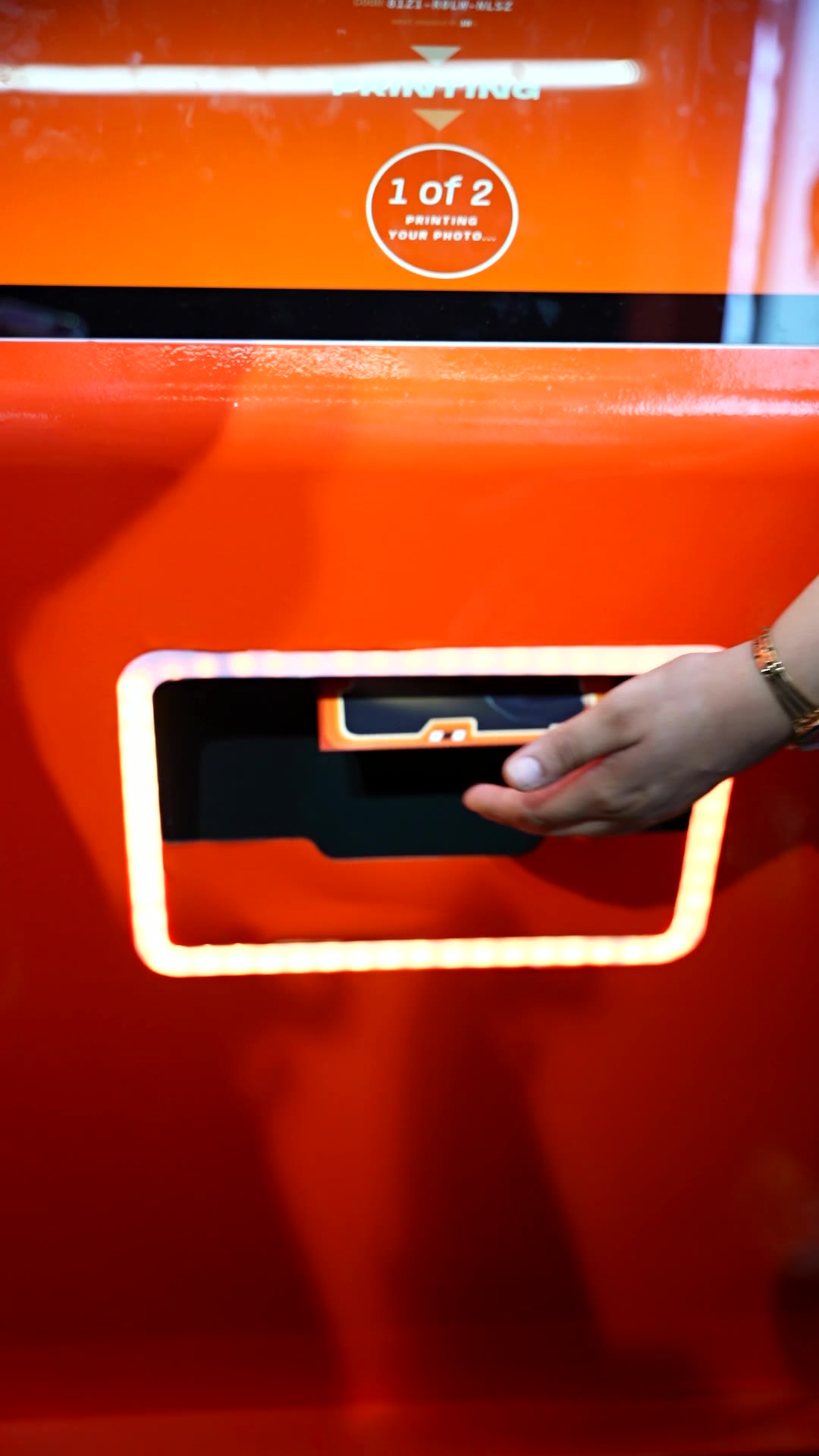
An AI photo booth uses the same core hardware — a camera, display, and printer — but adds a layer of artificial intelligence that fundamentally changes what the booth can do.
- Camera input — a DSLR, mirrorless camera, or high-resolution webcam captures the image
- AI processing — software performs real-time face detection, auto-exposure, auto-focus, and pose guidance
- Real-time effects — background removal and replacement, AI beauty filters, skin retouching, style transfer (turn photos into paintings, anime, cartoons), and age/gender transformation effects
- Generative AI art — the latest booths offer modes where your photo is transformed into oil paintings, watercolours, comic book art, or AI-generated scenes using diffusion models
- Self-service delivery — QR code for digital download, optional dye-sublimation printing, direct sharing to WhatsApp or social media
- Automated payment — UPI, credit/debit card, or wallet integration for fully unmanned operation
The key difference is automation. An AI booth can process a complete session — from payment to delivery — without any human intervention. It can handle 1,000+ images in 5 minutes of AI processing time, compared to roughly 10 hours for manual editing of the same volume.
AI Photo Booth: Setup Costs
Pikcha Lite (entry tier)₹3,50,000 + GSTBlack powder-coat cabinet, 21.5-inch touchscreen, 200+ AI effects, UPI built in, 1-year warranty Pikcha Studio (mid tier)₹4,50,000 + GST4K camera, dye-sub printer, industrial 21.5-inch touchscreen, silver-chrome cabinet, 1-year warranty Pikcha Pro (premium)₹6,50,000 + GSTFull white-label, custom wrap and colours, custom workflow, 1-year warranty, unlimited frame changesThe higher price reflects the integrated kiosk enclosure, payment hardware, AI software licensing, and the engineering required to make everything work as a self-service unit.
Key Features Unique to AI Photo Booths
- Real-time background removal and replacement — swap backgrounds instantly without a green screen, using AI segmentation that works with any backdrop
- AI-powered beauty filters — skin retouching, blemish removal, and lighting correction applied in real time, not post-production
- Face recognition for repeat visitors — personalise the experience for returning customers at permanent installations
- On-screen pose guidance — AI detects body position and suggests adjustments for better composition
- Generative AI art modes — transform photos into paintings, cartoons, anime, caricatures, or AI-generated fantasy scenes
- Automated crowd analytics — track session counts, peak hours, popular effects, and customer demographics
- QR code digital delivery — guests scan to download, eliminating the need for printing entirely if desired
- UPI and card payment integration — fully unmanned revenue collection with real-time transaction reporting
- Remote monitoring dashboard — check machine status, paper levels, revenue, and errors from anywhere
Pros of AI-Powered Photo Booths
- Fully automated operation — can run unmanned 12-16 hours a day, 7 days a week, dramatically reducing labour costs
- Real-time editing eliminates post-processing — every photo is delivered ready-to-share within seconds
- Higher throughput — sessions take 1–2 minutes compared to 2–3 minutes for traditional setups
- More creative output options — AI art, style transfer, background replacement, and generative effects give customers variety that keeps them coming back
- Data collection and analytics — understand your customers, optimise pricing, and identify peak periods
- Self-service payment — UPI and card acceptance means no cash handling and transparent revenue tracking
- Ideal for permanent installations — malls, multiplexes, tourist attractions, and airports where 24/7 availability drives revenue
- Strong appeal to younger demographics — Gen Z expects interactive, AI-enhanced experiences; 77% prefer interactive or augmented content over static alternatives
Cons of AI-Powered Photo Booths
- Higher initial investment — entry-level starts at ₹2 lakh, and a production-ready permanent setup runs ₹3–8 lakh
- Internet dependency for some features — cloud-based AI effects and generative art modes require a stable connection; offline fallback modes are essential
- Ongoing software costs — AI software updates, cloud processing fees, and licensing can add ₹15,000–50,000 per year
- Technology learning curve — initial setup and troubleshooting require more technical knowledge than a DSLR-based system
- Some AI effects can look artificial — particularly generative art and heavy beauty filters; quality varies by software provider
- Hardware complexity — more integrated components mean more potential failure points compared to a simple camera-laptop-printer chain
Head-to-Head Comparison
Setup cost₹1.2 – 4.5 lakh₹2 – 8 lakh Image qualityExcellent (raw sensor output)Very good (AI-enhanced) Automation levelLow (needs attendant)High (can run unmanned) Real-time effectsBasic filters and overlaysAI filters, art, backgrounds, style transfer Print capabilityDye-sublimation printingDye-sub printing + QR digital delivery Payment integrationManual collectionUPI, card, automated billing Throughput per session2–3 minutes1–2 minutes MaintenanceCamera, printer, props upkeepSoftware updates + hardware maintenance Best use caseEvents, weddings, corporateMalls, kiosks, events, weddings, tourist spots Monthly revenue potential₹40,000 – ₹3,75,000₹60,000 – ₹9,00,000 Staffing needs1–2 per event0–1 (part-time for permanent setups) ROI timeline3–6 months3–10 months Internet requiredNoFor some AI features, yes ScalabilityLimited by operator availabilityHigh (unmanned = multiple locations)Revenue Comparison: Traditional vs AI
Traditional DSLR — Event Rental Model
The standard business model for traditional booths is event-based rental:
- Rate per event: Confirm the quote for the event type, duration and city.
- Events per month: 6–15 (realistic for a single operator)
- Monthly revenue: ₹48,000 – ₹3,75,000
- Annual revenue: ₹5,76,000 – ₹45,00,000
After deducting consumables, transport, and attendant wages, net margins typically range from 50–70% for a well-run operation.
The ceiling is limited by the number of events you can physically attend. Scaling means hiring more operators and buying more equipment sets — a linear growth model.
Starting a Photo Booth Business?
Get AI photo booth pricing and ROI details from our team. No obligation.
AI-Powered — Permanent Installation Model
AI booths unlock the permanent installation model, which generates recurring daily revenue:
- Rate per session: ₹149 – ₹299
- Sessions per day: 30 – 200 (depending on location and foot traffic)
- Monthly revenue: ₹1,35,000 – ₹9,00,000
- Annual revenue: ₹16,20,000 – ₹1,08,00,000
After rent (₹30,000–1,50,000/month for mall space), consumables, electricity, and software costs, net margins range from 40–65% for well-located installations.
The advantage is compounding: once you prove a location works, you can replicate the setup across multiple sites with minimal additional labour. Revenue scales with locations, not headcount.
Hybrid Model — Events + Permanent
Many operators are now running both models simultaneously:
- AI booths at 2–3 permanent mall or tourist locations generating baseline monthly revenue
- The same or separate equipment available for weekend event rentals at premium rates
- Combined monthly revenue potential: ₹2,00,000 – ₹12,00,000+ across all locations and events
Market Context: Why This Decision Matters Now
Several converging trends make 2026 a pivotal year for the photo booth industry in India:
- India wedding market: valued at $130 billion with approximately 10 million weddings per year — photo booths are becoming a standard addition to wedding entertainment budgets
- Korean 4-cut booth trend: growing at 12.3% CAGR in India, driven by K-pop and K-drama fandom; this format relies heavily on AI and automation
- Gen Z spending power: $860 billion globally (43% of total consumption), projected to reach $2 trillion by 2035; this demographic overwhelmingly prefers interactive, tech-forward experiences
- 77% of Gen Z prefers interactive or augmented content over passive formats — AI booths deliver exactly this
- UPI adoption: India processed 16.6 billion UPI transactions in December 2024 alone — cashless self-service kiosks are now mainstream consumer behaviour
- Mall and retail expansion: India is adding 15–20 million sq ft of organised retail space annually, creating new locations for permanent installations
Which Should You Choose?
Choose a Traditional DSLR Booth If:
- Your primary business model is event rentals (weddings, birthdays, corporate events)
- You are budget-conscious and want to test the market with a lower initial investment
- You value raw image quality and want the best possible sensor output for professional photography
- You have existing photography skills and equipment that can be repurposed
- Your events are frequently in venues without reliable internet (farmhouses, outdoor locations, remote destinations)
- Your clients specifically request traditional photo booth experiences with physical prints and props
Choose an AI-Powered Booth If:
- You are planning permanent installations in malls, multiplexes, tourist spots, or airports
- You want unmanned operation to minimise labour costs and enable scaling to multiple locations
- Your target audience is Gen Z and millennials who expect interactive, shareable, tech-forward experiences
- You are interested in the Korean 4-cut photo booth format, which inherently requires AI and automation
- You want to offer corporate brand activations with custom AI filters, branded backgrounds, and data capture
- You want integrated payment and analytics for transparent, data-driven business decisions
- You plan to scale to multiple locations and want a replicable, low-maintenance model
Choose Both If:
- You want to cover events AND permanent installations to diversify your revenue streams
- You are building a photo booth rental company that needs different solutions for different client needs
- You want to maximise total revenue — use AI booths for permanent locations and traditional setups for high-end events where raw image quality matters most
- You are entering the photo booth franchise space and want to offer multiple formats to franchisees
The Bottom Line
Traditional DSLR photo booths are not going away — they remain the best choice for operators focused purely on event rentals, especially at weddings and high-end corporate functions where image quality and the tangible print experience matter most. The lower startup cost makes them accessible for testing the market.
AI-powered photo booths, however, represent the growth trajectory of the industry. The ability to operate unmanned, collect digital payments, offer creative AI effects, and generate recurring revenue from permanent installations makes them the stronger choice for operators thinking about scale and long-term profitability.
For most new entrants to the Indian photo booth market in 2026, an AI-powered setup is the better investment — the higher upfront cost is offset by lower operating expenses, higher throughput, and access to the permanent installation revenue model that traditional booths cannot serve.
Get Started with Bamigos
At Bamigos, we manufacture and supply AI-powered photo booths designed specifically for the Indian market. Our systems combine the best of both worlds — DSLR-quality cameras with AI processing, dye-sublimation printing, UPI payment integration, and fully customisable branding.
Whether you need a single booth for event rentals or a fleet of kiosks for mall installations, we provide:
- Turnkey photo booth systems — camera, AI software, printer, payment terminal, and kiosk enclosure
- DSLR integration — use professional-grade cameras with AI-enhanced processing for the best image quality
- UPI and card payment — fully unmanned revenue collection with real-time reporting
- Custom branding — your logo, colours, and frame designs on every output
- Pan-India service reach
- Ongoing technical support and consumable supply
Ready to choose the right photo booth for your business?
Contact our team for a consultation and equipment pricing. Or call us directly at +91-8310204172.
View Photo Booth Pricing · Explore Franchise Opportunities · See Our Equipment
Which Pikcha tier fits your business
Bamigos manufactures the Pikcha AI Photo Booth — built in India by Bamigos — across three tiers:
- Pikcha Lite (₹3.5 L + GST) for entry operators and first-booth buyers
- Pikcha Studio (₹4.5 L + GST) for serious mall/FEC/hotel installations with co-branded print frames
- Pikcha Pro (₹6.5 L + GST) for franchise networks and full white-label buyers
All three tiers ship with 200+ AI effects, 21.5" industrial touchscreen, UPI built in, and lifetime software updates. Post-warranty operation requires a mandatory AMC at 9.5% of base price per year. Logistics ex-Delhi and optional on-site setup are quoted separately. See full Pikcha pricing.
Note: After the warranty period ends, Pikcha requires a mandatory Annual Maintenance Contract (AMC) at 9.5% of base price per year. See the full AI Photo Booth Price India page for AMC details, logistics, and setup policy.