![6 Mall Kiosk Businesses That Earn ₹1L+/Month [India 2026]](/uploads/mall-kiosk-business-ideas-india-2026.webp)
Mall Kiosk Business Ideas in India 2026: 6 Businesses That Work in 36 Square Feet
A small kiosk spot in an Indian mall pays ₹15,000–₹50,000 per month in rent. That means whatever you put in that space needs to generate at least ₹60,000–₹1,00,000 per month in gross revenue just to break even after rent, staff, and inventory. Most "mall business ideas" articles list 30 options without checking whether a single one actually works at those rent levels.
This guide covers six kiosk businesses that Indian mall operators are actually running profitably in 2026 — with real revenue numbers, rent-adjusted margins, and an honest assessment of which ones survive when the landlord raises rent.
The Mall Economics You Need to Know First
Before picking a business, understand how mall revenue works in India:
- Average mall kiosk rent (metro): ₹15,000–₹50,000/month for a 30–50 sq ft space in a common area
- Revenue share model (alternative): 15–30% of gross revenue to the mall, no fixed rent
- Common Area Maintenance (CAM): ₹50–₹150 per sq ft per month, on top of rent
- Security deposit: 3–6 months' rent upfront
- Peak footfall days: Weekends (2–3x weekday traffic), festivals (Diwali, Christmas: 3–5x)
- Average metro mall daily footfall: 15,000–30,000 visitors
The highest-profit kiosk businesses are the ones with high per-transaction revenue and low ongoing costs. Selling ₹20 phone covers at 50% margin requires 200+ sales per day to clear ₹60K/month. A ₹149 photo session with 75% margin needs only 15 sessions per day.
Margin per transaction matters more than volume.
1. AI Photo Booth Kiosk
Space needed: ~6.3 sq ft machine footprint (3.29 ft × 1.92 ft) + 4–6 ft in front for the customer
Investment: ₹3.5–6.5L + GST (booth) + ₹30K–₹1L (first month rent + deposit)
Monthly revenue: ₹1,20,000–₹3,75,000
Monthly net profit: ₹50,000–₹1,20,000 (after rent and consumables)
Staff: Zero — fully self-service
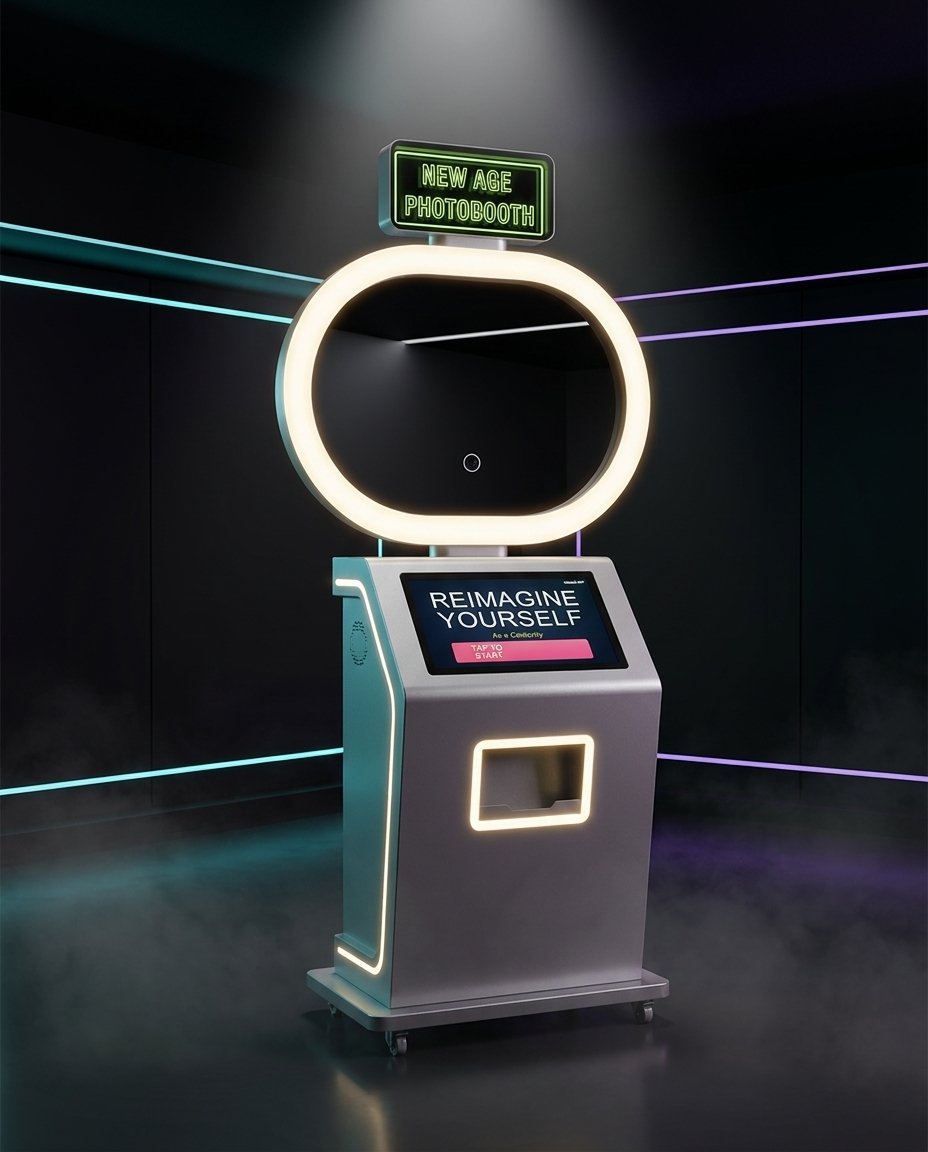
An AI photo booth is a self-service kiosk that runs on UPI payments. Customers pay ₹149–₹299 per session, choose from 200+ AI effects on a touchscreen, and receive an instant print plus a WhatsApp download — all in 90 seconds, without staff.
Why it dominates mall kiosk economics:
The unit economics are brutal for every other kiosk business and favourable for this one. Here is why:
A photo booth at ₹149/session with 45 sessions/day generates ₹2,01,150/month gross. After rent (₹30,000), consumables (quoted for your venue), electricity (₹2,000), and maintenance reserve (₹3,000), net profit is ₹1,18,900. That is a 59% net margin on gross revenue — in a mall, where most businesses are happy with 20–30%.
The reason is structural: there is no inventory to buy, no staff to pay, no spoilage, and no theft. The machine runs from mall open to mall close without a break. Every UPI payment is collected by Bamigos and transferred to your bank account bi-weekly — with a complete digital trail on the operator dashboard.
Placement matters: Near the food court, cinema exit, or main atrium. Avoid basement floors, back corridors, and dead zones behind escalators. The difference between a great and mediocre placement is 3–4x in daily sessions.
The Pikcha AI Photo Booth is designed for Indian mall environments — compact 6.3 sq ft footprint, built-in UPI, 200+ AI effects, and a remote dashboard for monitoring from anywhere. Three tiers available from ₹3.5L (Lite) to ₹6.5L (Pro).
Calculate your mall booth ROI →
2. Juice and Smoothie Bar
Space needed: 50–80 sq ft
Investment: ₹3–6L (equipment + initial stock + fitout)
Monthly revenue: ₹1,50,000–₹3,00,000
Monthly net profit: ₹30,000–₹70,000
Staff: 2 (one counter, one prep)
Fresh juice bars work in malls because they serve an impulse purchase to a captive audience. A mango smoothie at ₹150–₹250 has a 65–70% gross margin. At 40–80 drinks per day, the numbers add up.
The math:
60 drinks/day × ₹180 average × 30 days = ₹3,24,000 gross. Cost of goods (₹1,05,000) + rent (₹35,000) + two salaries (₹24,000) + electricity (₹5,000) + CAM (₹8,000) = ₹1,77,000 expenses. Net: ₹1,47,000.
Reality check: This looks great on paper, but depends heavily on seasonal fruit prices, staff reliability, and footfall consistency. Weekday volumes can drop 50% below weekends. Staff absenteeism during festivals (when you need them most) is chronic. You are also competing with major chains (Raw Pressery, Juice Lounge) that have brand recognition you do not.
Best for: People who want a food business and can manage daily operations. Not passive — this is a full-time commitment.
3. Mobile Accessories and Phone Repair
Space needed: 40–60 sq ft
Investment: ₹2–4L (inventory + display + tools)
Monthly revenue: ₹80,000–₹2,00,000
Monthly net profit: ₹20,000–₹50,000
Staff: 1–2
Phone accessories (covers, screen guards, chargers, earbuds) are universal impulse buys. Add screen repair and you have a higher-ticket service that draws customers deliberately.
The reality:
Accessories margins have been compressed by online pricing. A customer can check the Amazon price of any phone cover in 10 seconds. You need to compete on immediacy (they need it now) and service (screen repair cannot be done online). Average transaction: ₹200–₹500 for accessories, ₹500–₹1,500 for repairs.
At 30–50 transactions per day with a ₹350 average, gross revenue is ₹3,15,000–₹5,25,000 per month. But cost of goods is high (40–50%) and you need at least one skilled repair technician (₹15,000–₹20,000 salary). After all expenses, net profit sits at ₹20,000–₹50,000.
The risk: Inventory becomes obsolete quickly as phone models change. Last year's bestselling phone cover is this year's dead stock. You need to actively manage inventory rotation, which is a daily job.
Best for: People with mobile repair skills or supplier relationships. A hands-on, operationally intensive business.
4. Customised Merchandise Kiosk (T-Shirts, Mugs, Phone Cases)
Space needed: 40–60 sq ft
Investment: ₹3–5L (heat press, sublimation printer, blanks, display)
Monthly revenue: ₹60,000–₹1,50,000
Planning a Gaming Zone?
Get expert recommendations and pricing for your venue: including the Pikcha AI photo booth, a self-service photo attraction to evaluate for your venue. No obligation.
Monthly net profit: ₹15,000–₹40,000
Staff: 1
Print-on-demand merchandise — custom t-shirts, mugs, phone cases, cushion covers with customer photos or designs — attracts families, couples, and groups looking for a personalised souvenir.
The numbers:
Average transaction: ₹300–₹600 (one custom item). At 15–25 transactions per day: ₹1,35,000–₹4,50,000 gross per month. Request a quote for blanks and printing. After COGS, rent, one staff salary, and electricity, net margin is 25–35%.
The challenge:
This business has low barriers to entry — anyone with a ₹30K heat press can do it. In a busy mall, you will often find 2–3 competing kiosks. Price wars are common. Customer flow is also heavily weekend-dependent; weekday volumes can be painfully low.
Best for: Creative operators who enjoy personalisation and customer interaction. Works better in tourist-heavy malls.
5. EV Scooter/Phone Charging Station
Space needed: 10–20 sq ft
Investment: ₹2–4L (charging units + installation)
Monthly revenue: ₹15,000–₹40,000
Monthly net profit: ₹5,000–₹15,000
Staff: Zero
Phone charging stations (and increasingly, EV scooter charging) are the lowest-investment mall kiosk option. Install 4–8 charging lockers and a couple of EV scooter charging points near the parking entrance.
The reality:
Phone charging: ₹20–₹50 per charge session, 20–40 sessions/day. Monthly gross: ₹12,000–₹60,000. Net after electricity and rent: ₹5,000–₹20,000.
This is ultra-low-maintenance but also ultra-low-return. The space earns less per square foot than almost any alternative. It works as an add-on to another business (put a charging station next to your photo booth) but not as a standalone income source.
Best for: Supplementary income. Add it to an existing mall presence, do not build a business around it.
6. Candy/Snack Vending Cluster
Space needed: 15–30 sq ft (3–4 machines)
Investment: ₹2–4L
Monthly revenue: ₹30,000–₹70,000
Monthly net profit: ₹8,000–₹20,000
Staff: Zero (weekly restocking)
A cluster of 3–4 vending machines (cotton candy, popcorn, gumball, or packaged snacks) near a kids' play area or cinema can generate consistent low-ticket revenue.
The economics:
₹20–₹50 per item × 40–80 items/day across all machines = ₹24,000–₹1,20,000 gross/month. After product cost (40–50%), rent, and electricity, net is ₹8,000–₹20,000.
The margins are thin and the revenue ceiling is low. But it is genuinely passive (weekly restocking takes 30 minutes) and the capital requirement is the lowest on this list.
Best for: Minimal-effort supplementary income in a mall where you have another primary business.
Head-to-Head: Revenue Per Square Foot
The metric that matters most in a mall is revenue per square foot — because rent is charged per square foot.
| Business | Sq Ft | Monthly Net Profit | Profit/Sq Ft/Month | Staff | Passive? |
|---|---|---|---|---|---|
| AI Photo Booth | ~6 | ₹50K–₹1.2L | ₹8,300–₹20,000 | None | Yes |
| Juice Bar | 60 | ₹30K–₹70K | ₹500–₹1,167 | 2 | No |
| Mobile Accessories | 50 | ₹20K–₹50K | ₹400–₹1,000 | 1–2 | No |
| Custom Merchandise | 50 | ₹15K–₹40K | ₹300–₹800 | 1 | No |
| EV/Phone Charging | 15 | ₹5K–₹15K | ₹333–₹1,000 | None | Yes |
| Vending Cluster | 20 | ₹8K–₹20K | ₹400–₹1,000 | None | Yes |
The AI photo booth generates 2–4x more profit per square foot than any other option — and it does it with zero staff. That is why mall operators increasingly prefer photo booths over traditional retail kiosks: higher revenue per square foot with lower operational complexity.
How to Get Started
Step 1: Visit your target mall. Walk every floor. Identify the 3 best placement spots (food court adjacency, cinema exit, main atrium). Talk to the leasing team about kiosk availability and rates.
Step 2: Run the numbers. Use the photo booth ROI calculator to model your specific mall's footfall and pricing. If the payback is under 12 months at conservative estimates, proceed.
Step 3: Choose your equipment. The Pikcha AI Photo Booth is built for Indian malls — compact footprint, UPI integration, 200+ AI effects. Three tiers from ₹3.5L. See pricing →
Explore more: Photo Booth Manufacturer India · Buying Guide · Franchise
Frequently Asked Questions
Which kiosk business is most profitable in Indian malls?
Based on 2026 data, an AI photo booth generates the highest profit per square foot (₹8,300–₹20,000/sq ft/month) of any mall kiosk business. The zero-staff, UPI-automated model means nearly all revenue converts to profit after rent and consumables.
How much does it cost to set up a kiosk in a mall in India?
Mall kiosk space in metro malls costs ₹15,000–₹50,000/month for 30–50 sq ft, plus a 3–6 month security deposit. Total setup cost including the business ranges from ₹2L (vending machines) to ₹6.5L (AI photo booth with premium placement). Revenue share models (15–30% of gross to the mall) are available at some properties.
Can I run a mall kiosk business without being present daily?
Only certain kiosk businesses are truly unattended. AI photo booths, vending machines, and charging stations run without staff. Juice bars, accessories shops, and merchandise kiosks all require at least one person present during mall hours. If passive income is your goal, choose an automated option.
What is the minimum investment for a mall kiosk in India?
₹2–3 lakh for a basic vending machine cluster or phone charging station. ₹3.5–6.5L + GST for an AI photo booth (the highest-return option). ₹3–6L for a food or accessories kiosk. The kiosk space rent and deposit add ₹50K–₹3L on top depending on the mall tier and city.