Six weeks before go-live. Your client wants a custom-branded photo booth, an interactive floor game, and a VR zone at the mall activation. The brief landed Monday. The vendor you used last year has "production lead times of 10 to 12 weeks." The vendor you pitched yesterday won't quote without a Zoom call. Your AOR asks for a budget by Friday, and you still don't know what a fair number looks like.
If that paragraph reads like a normal week for you, this guide is written for your job, not for Google.
We put this together because agency producers keep asking the same six questions when they brief us, and nobody in the Indian experiential space has written the answers down in one place. Not what we sell, not what you should buy from us — the actual mechanics of specifying, budgeting, scheduling, and shipping a custom interactive experience in the Indian market in 2026. What's technically possible, what real timelines look like when nobody is lying to you, what the budget bands actually are, and what to put in your brief so you don't get ambushed by a revised quote in week four.
Bookmark this or forward it to the producer who's about to inherit a pitch. It is long because the work is detailed, and short answers to detailed questions is how campaigns get into trouble.
What "custom" actually means in experiential tech
Start here because this is where most agency briefs lose money. "Custom photo booth" can mean five different things to five different vendors, and the price difference between them is about seven lakhs.
The five levels of customisation, cheapest to most expensive:
Level 1 — Branded wrap only. Take an existing booth off the shelf, put your client's logo and brand colours on a vinyl cabinet wrap, hand it over. 24-48 hour turnaround. Cheapest. Completely reversible after the activation. Problem: everyone can tell it's a stock booth with a sticker on it.
Level 2 — Branded wrap plus branded print layout. Same booth, same wrap, but the photo strip or print output carries the client's logo, call-to-action, campaign hashtag, and brand colours. 2-3 day turnaround with template design. Good for social activations where the photo is the deliverable.
Level 3 — Branded wrap plus custom UI. The on-screen user interface is redesigned for the brand — fonts, colours, button styles, welcome screen, brand-voice microcopy. The user interaction still follows the standard flow: walk up, tap to start, take photo, pick effects, print. 1-2 weeks depending on how much design polish the client wants. This is where most "custom" agency briefs actually sit, and it's the sweet spot for budget vs impact.
Level 4 — Custom workflow. The user journey itself changes, not just the visual layer. Example: a car brand wants guests to "build" their dream configuration on a touchscreen, then the booth takes a photo with the configured car rendered behind them, and the print includes a QR code to a test-drive booking page. That's a custom workflow. It requires actual software work — screens, logic, integrations. 3-5 weeks.
Level 5 — Full custom hardware build. New cabinet, new form factor, new screen layout, custom mechanical parts, integration with external systems (RFID, loyalty APIs, sensors, lighting rigs). 6-10 weeks minimum in India. This is what brands buy for flagship activations at Auto Expo, IPL opening ceremonies, or major mall launches. Budget starts at a different number than anything above.
The trap in agency briefs: a client says "custom photo booth" and means Level 4 or 5, the budget matches Level 2, and the timeline expects Level 1. When the producer reconciles those three numbers with a vendor, the conversation either dies or the vendor over-promises to win the pitch and the campaign implodes in week five.
The fix: write your brief specifying which level you want. Ask for a price band for Level 2 and a price band for Level 4, and let the client see what buying the word "custom" actually costs.
The four product categories that actually matter for brand activations in India
Not everything marketed as "experiential tech" survives a mall Sunday or an Auto Expo week. These four categories do, and they're what most brand activations in India are built from:
1. AI photo booths
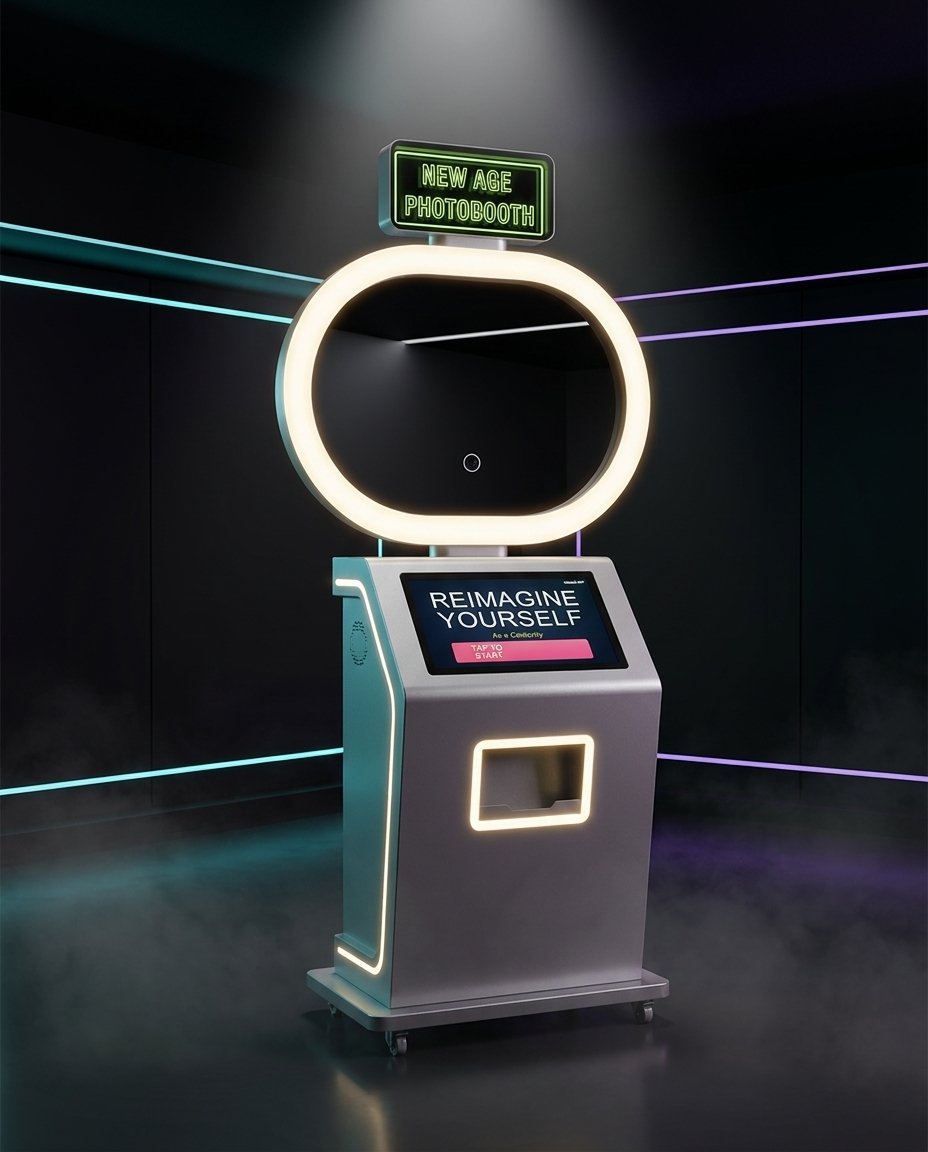
The workhorse of Indian brand activations since 2023. Guests walk up, take a photo, the booth applies an AI effect (cartoon, anime, K-pop, Bollywood, superhero, custom branded effect), prints in 8-10 seconds, shares on WhatsApp. At a mall activation you can do 400-800 sessions per day on a single booth. At a wedding or corporate event, 200-500 sessions. At a trade show, 150-300 depending on footfall.
Why it works for brands: every session produces a shareable asset that carries the brand's logo into the guest's social feed. A Pikcha booth running for a 3-day mall activation generates 1,500+ social shares with a measurable reach.
Customisation at Level 3 adds your UI. Level 4 adds branded effects (the guest transforms into your brand mascot, or into a driver inside your car, or into a cricket player in your kit). Level 5 adds custom form factors — photo booths shaped like giant product packaging, cars, bottles.
2. Interactive projection (floor + wall games)
A projector throws an image on a floor or wall, a sensor tracks movement, guests interact by walking, jumping, touching, kicking. Games range from ball-pit simulations to branded puzzles, stepper challenges, branded gesture-based mini-games.
Why it works for brands: high engagement, kids + adults both play, footprint can be configured to fit any venue from a 4×6 ft patch to a full wall. Dwell time is longer than photo booths — a guest might spend 5-8 minutes with an interactive floor game vs 90 seconds in a photo booth.
Customisation: games can be re-skinned with the brand's characters, colours, and rules. A new custom game (entirely new rules, not just a re-skin) is Level 5 and takes 4-8 weeks.
3. VR zones
A VR headset with a branded experience — a product demo in VR, a showroom walkthrough, a brand-story experience. Best for auto launches, real estate, tourism boards, and anything that benefits from "seeing the thing you can't fit in the venue."
Why it works for brands: guests remember VR better than they remember regular activations, by a measurable margin in post-event surveys. The trade-off is throughput — one headset can only do 3-5 minute sessions, so you need multiple stations for high-footfall venues.
Customisation: a new VR experience built from scratch for a specific campaign is a 4-6 week job and costs more than any other category. Re-skinning an existing VR demo with new branding is 2-3 weeks.
4. Smart interactive installations
Everything else: custom touchscreen kiosks, interactive darts, smart trampolines with projected graphics, claw machines, arcade cabinets re-skinned to the brand, ticket redemption games repurposed as lead-capture mechanisms.
These are hit-or-miss for brand activations. They work brilliantly when the brand has a playful personality (FMCG, gaming, sports, youth fashion) and are a waste when the brand is trying to be serious (finance, B2B, healthcare).
A composite example
A car launch at a mall activation might deploy all four: a custom AI photo booth at the entrance (guests pose "in" the car via AI effects), a branded interactive floor game in the centre (drive a virtual version of the car through a simple obstacle course), a VR test-drive zone in the corner, and a smart interactive leaderboard showing top scores. One vendor can supply all four. Most can't, which is why agencies end up coordinating three or four suppliers and dealing with three separate delivery calendars.
Budget bands for custom experiential tech in India (2026)
This is the section agency producers bookmark.
These are all-inclusive prices in ₹ lakhs, plus GST, for the Indian market in April 2026. They exclude venue rental, guest service staff, food and beverage, and campaign production costs. They include hardware, custom branding at the level stated, installation, 24-hour on-site tech support during the activation, and breakdown.
AI photo booth — rent
Bamigos offers photo booth rentals across India. Brief us on the event cities, dates, operating hours, branded screens, effects and print format. We quote the creative scope, print allowance, staffing, transport, setup and applicable taxes for your activation.
Multi-day and multi-city bulk rates negotiable. Confirm the print quantity, transport, setup, staffing and collection in the quote for each event.
AI photo booth — buy
| Tier | Description | Price (+ GST) |
|---|---|---|
| Pikcha Lite | Entry-tier commercial AI booth — black powder-coat cabinet, 21.5" standard touchscreen, 200+ AI effects, UPI built in, 1-year warranty | ₹3.5 Lakhs |
| Pikcha Studio | Silver-chrome cabinet, 21.5" industrial-grade touchscreen, 4K camera, reactive ambient lighting, 80% buyer-branded print frames, 1-year warranty | ₹4.5 Lakhs |
| Pikcha Pro | Silver chrome + custom cabinet wrap in any colour, custom UI, up to 3 custom workflows, 100% white-label print frames, 1-year warranty, dedicated account manager, 4-hour priority SLA. | ₹6.5 Lakhs |
The Pikcha Pro tier is the buy-version of Level 4 / Level 5 custom — full white-label with custom cabinet wrap, UI, and workflow — available as a single unit. For co-branded commercial buys the Pikcha Studio tier covers Level 2 / Level 3 customisation depth with co-branded print frames and industrial-grade hardware. Agencies typically rent for one-off activations and buy for recurring brand ownership — a brand that runs a photo booth activation every quarter usually breaks even on a Pikcha Studio purchase by month 4.
Interactive projection — floor and wall games
| Level | Description | Rent per day | Buy price |
|---|---|---|---|
| Off-the-shelf | Standard game library, no branding | Contact for pricing | ₹3 - 5 Lakhs |
| Level 3 | Game library with branded visual theme | Contact for pricing | ₹5 - 7 Lakhs |
| Level 5 | Entirely new game built for the campaign | Contact for pricing | ₹8 - 15 Lakhs |
VR zones
For a VR activation, specify the experience, number of stations, guest age range, event hours and venue layout. Ask for a quote covering the hardware, content, hygiene arrangements, power, staffing, transport and installation. Bespoke VR content should have its own scope and approval schedule.
Why these numbers vary by level, not by vendor
The hardware cost of an AI photo booth doesn't change between Level 1 and Level 4 — it's the same industrial touchscreen, the same dye-sublimation printer, the same 4K camera. What changes is engineering time. A Level 4 custom workflow might take 40-60 hours of software development, UX design, and testing. That's the line item you're paying for. When a vendor quotes the same price for Level 2 and Level 4, one of two things is happening: they're losing money on the higher level (they won't deliver), or they're overcharging on the lower level (you're overpaying).
A trustworthy vendor will happily break out their quote into "hardware + Level X engineering time." Any vendor who refuses is either hiding their cost structure or doesn't have one.
Lead times that actually hold
The single most damaging thing in experiential project management is a lead time that slips in week four. Here are the real lead times for custom experiential tech in India, from the day the brief is final to the day the booth is on-site and operational.
| Deliverable | Minimum | Realistic | Safe |
|---|---|---|---|
| Off-shelf rental, no customisation | 3 days | 7 days | 10 days |
| Level 2 — wrap + branded print layout | 7 days | 10 days | 14 days |
| Level 3 — wrap + custom UI | 14 days | 21 days | 28 days |
| Level 4 — custom workflow | 21 days | 35 days | 42 days |
| Level 5 — full custom build | 42 days | 60 days | 75 days |
| Custom VR experience | 30 days | 45 days | 60 days |
| Custom interactive game (new rules) | 35 days | 50 days | 65 days |
| Multi-city tour deployment | add 5 days per city | add 7 days | add 10 days |
How to read this table: the "minimum" column is what you'll hear in a pitch call. The "realistic" column is what the vendor can actually deliver on 80% of projects. The "safe" column is what you should plan for in your campaign calendar if your client's go-live date is non-negotiable.
Working backwards from a campaign launch on June 1st, a Level 3 custom photo booth brief needs to be final by April 20th to be delivered safely. A Level 5 full build needs to be final by March 17th. If the brief lands in your inbox 5 weeks before launch and the client wants Level 4 custom, something has to move — either the scope comes down to Level 2/3, or the budget goes up enough to pay for emergency engineering + parallel workstreams, or the launch date moves.
Planning a Gaming Zone?
Get expert recommendations and pricing for your venue: including the Pikcha AI photo booth, a self-service photo attraction to evaluate for your venue. No obligation.
Don't promise Level 5 in 4 weeks. We have never seen it delivered to a standard the client was happy with. What we have seen is Level 5 promised in 4 weeks, delivered in 6, with the activation day shifted.
How to brief a vendor for custom experiential tech
This is where most of the over-runs start. A good brief saves 2 weeks of back-and-forth and eliminates 80% of scope creep. Here's what a vendor actually needs to quote you accurately on day one.
The 12 fields every custom experiential brief should have
1. Campaign context. One paragraph. What is the campaign, which brand, what is the objective, what is the creative angle? Vendors need this to suggest the right deliverable. Don't assume we can work it out from the product spec — the same "custom photo booth" brief has different answers for a luxury watch brand vs a cricket fan engagement.
2. Go-live date and venue(s). Non-negotiable date and every confirmed venue. If multi-city or multi-day, list each location and operating hours. Power availability, internet availability, footprint dimensions available for the activation, venue access time for setup and breakdown.
3. Expected footfall and dwell targets. Daily footfall expectation, peak hour count, target sessions per hour. A Level 3 AI photo booth can handle about 40 sessions/hour sustained, 60 peak. If your brief needs 100 sessions/hour, you need two booths or a different form factor.
4. Custom scope level (1-5). Name it. "Level 3 — wrap + custom UI" or "Level 4 — custom workflow including [specific behaviour]." Avoids the entire "what do you mean by custom" debate.
5. Deliverable outputs. What does the guest walk away with? A 4×6 physical print, a 2×6 strip, a digital photo via WhatsApp, a video reel, a certificate PDF, a lead capture form submission. Be specific. "Photo" is three different deliverables with three different production costs.
6. Brand asset package. Logo (SVG or EPS), brand colour codes (hex + CMYK), typeface files or licensed font names, brand guidelines PDF, any existing brand-approved illustrations or imagery you want used. If you send a JPG of a logo as the only asset, the vendor has to recreate it from scratch and there will be a delay.
7. User journey in plain English. "Guest walks up, sees welcome screen with brand greeting, taps to start, is asked to select one of three moods, takes a photo, sees three AI effect previews, picks one, print comes out with branded overlay, WhatsApp message sent with digital version + test-drive booking link." Six sentences. Not a 40-slide deck. If you can't describe it in six sentences, the scope isn't finalised yet.
8. Integration requirements. Does the booth need to talk to a brand CRM, a loyalty system, a lead capture API, a WhatsApp business account, an Instagram posting automation? Name each system with a contact for their technical team.
9. Staffing and training requirements. Will guest service staff be provided by the agency, by the brand, or do you need trained operators included in the vendor package? How many hours of on-site tech support do you expect, and is it included in the quote or extra?
10. Post-activation disposition. What happens to the booth after the campaign? Returned to the vendor, disposed of, retained by the brand for future use, donated, or re-skinned for the next campaign? This changes the vendor's pricing — a Level 5 build that's retained by the client is more expensive than one that comes back to the vendor's warehouse, because the vendor can't re-deploy it.
11. Budget ceiling (approximate is fine). Share your budget ceiling, event dates and cities. Vendors who refuse to talk budget-first will quote high and retreat. Vendors who know your ceiling can either deliver within it or walk away early, both of which save weeks.
12. Decision maker and decision timeline. Who approves the quote, by when, and what does the approval workflow look like? A 3-week approval pipeline with 4 sign-offs is the single biggest source of missed deadlines. If your agency knows the approval will take 2 weeks, start the vendor conversation 2 weeks earlier.
What not to put in the brief (yet)
- Specific competitor references. "We want what XYZ Brand did at Auto Expo" is useful as a visual reference but useless as a spec. Describe the experience, not the vendor who built it.
- "Something wow." Not a brief. Not a scope. Not a price signal. Every vendor hears "maximum creative licence at minimum budget."
- "We'll share the logo later." If the logo isn't confirmed at brief time, the Level 3+ custom design work can't start. Don't start the clock on a custom build until the brand team has signed off on the logo.
Red flags when evaluating an experiential vendor
You know most of these. The ones you might not:
1. No published price bands. Any vendor whose response to "how much for a custom photo booth" is "let's get on a call" is playing a pricing game. They're measuring your budget sensitivity before committing. This always ends with a quote that sits right at the top of what they think you'll pay. A vendor with published tier pricing gives you a floor to negotiate from.
2. No published lead time. "Fast turnaround" and "express delivery available" are not lead times. "Level 3 in 3 weeks, Level 4 in 5 weeks, Level 5 in 8 weeks" is a lead time. If a vendor can't tell you in weeks what their build time is, either they don't build their own hardware or they don't want you to know.
3. "Industrial grade" without specs. Any photo booth in a mall setting will be tapped 50,000+ times over a 30-day activation. Cheap consumer touchscreens develop dead zones at around 60-80,000 taps. If the vendor says "industrial touchscreen" but can't name the brand, model, or tap rating of the screen, assume it's a consumer-grade panel with a label on it.
4. No factory and no brand of their own. Some "experiential tech vendors" are agencies themselves, white-labeling a cheaper OEM booth from China or a reseller in Chennai. You find out when the hardware arrives looking different from the render and the spare parts lead time is 4 weeks. Ask where the booth is built. If they can't answer, assume it's being imported.
5. Payment terms heavy on upfront. 80%+ upfront on a ₹10 Lakh project is a red flag. Reputable vendors work with 40-50% upfront, 30-40% on delivery at venue, 10-20% on activation completion. Vendors who won't work to milestone payments are either cash-strapped or have burned through trust on prior projects.
6. Vague scope definitions. "Full branding included" is not a scope. "Cabinet wrap with 1 design iteration, UI skin with 2 design iterations, 1 branded print layout, 1 branded welcome screen" is a scope. Ambiguity at brief time is the thing that creates change orders at delivery time.
7. No post-activation support plan. What happens if the booth crashes on day 2 of a 3-day activation? Does the vendor have a spare booth on standby in your city? Can they dispatch a tech in 2 hours? Or do you file a warranty ticket and pray? For any activation over ₹5 Lakhs, the post-activation support plan should be a line item in the contract.
The 5-step process from brief to activation
Using a Level 3 custom AI photo booth as the reference example, here's what a disciplined delivery looks like:
Week 1 — Brief finalised + design approval. Days 1-2: client approves the brief. Days 3-4: vendor returns a custom design concept (cabinet wrap render + UI mockups). Days 5-7: agency + brand team finalise the design iteration. Design sign-off by end of week 1 or the project will slip.
Week 2 — Build + integration. Days 8-10: vendor starts fabrication (printing the wrap, wrapping the cabinet, uploading the UI skin to the booth software). Days 11-14: integration testing — brand colours on-screen, print layout QA, WhatsApp delivery flow end-to-end.
Week 3 — UAT + shipping. Days 15-17: user acceptance testing. Agency producer does a walkthrough. Brand team signs off. Days 18-19: final adjustments, pack the booth. Days 20-21: ship to the activation venue, install, power-up test.
Day of activation. Setup at venue, tech check, soft-launch with internal team, doors open. On-site tech present for full activation.
Post-activation. Breakdown, return-ship to vendor warehouse, post-campaign report (session count, print count, WhatsApp delivery rate, reach metrics). Deliverable: a closeout deck the agency can forward to the client.
Total calendar days: 21 days from brief-final to activation live, with 5 days of buffer baked in. Works backwards: if your activation is May 1st, your client's final sign-off on the brief + brand assets needs to be April 10th.
When to rent vs when to buy
Most agencies rent for every custom activation and never think to recommend the alternative. Sometimes buying is cheaper — even in the short term — and it's worth knowing when.
Rent makes sense when
- One-off activation, single city, single date
- Brand is testing the channel for the first time
- Budget is under ₹3 Lakhs and the scope is Level 2 or 3
- Post-activation disposition is "return to vendor"
- No plans for a second activation in the next 6 months
Buy makes sense when
- The brand runs 4+ experiential activations per year
- The campaign is a multi-city tour (8+ cities) — the 8th day of rental across 8 cities usually exceeds the purchase price
- The brand wants to keep the booth as a permanent installation in a showroom, flagship store, or corporate lobby
- Scope is Level 3 or above and the brand plans to re-skin for future campaigns
- Compare the total campaign rental quote with the purchase and operating costs.
The math for a multi-city tour: request a rental quote for every event day and city. A Pikcha Studio purchase at ₹4.5 Lakhs (plus GST) owns the booth forever, with an industrial-grade touchscreen and 1-year warranty, and re-skins are ₹25,000–50,000 per campaign after that. If the brand wants full white-label (no Pikcha mention on the cabinet or in print frames), that is Pikcha Pro at ₹6.5 L + GST — available as a single unit, so it works for a franchise or chain buyer as well as a single-brand one-off. Compare the confirmed rental quotes with purchase and operating costs over your planned campaigns.
Tell the client the math honestly. It costs you a one-time rental margin but wins you a long-term relationship as the trusted vendor who recommends the right answer.
What an agency producer should demand from any custom vendor
A short list to check against before you sign the contract:
- A published price band for each custom level (1 through 5)
- A published lead time for each custom level
- A spec sheet for the hardware with brand, model, rated lifetime, and warranty terms
- A design review and approval gate before fabrication starts
- A UAT day built into the calendar before shipping
- On-site tech support during the full activation window, not an hourly rate
- Spare parts in your city or same-day dispatch from the vendor's warehouse
- Milestone payments (not 80% upfront)
- A named project manager who is your single point of contact
- A post-activation closeout report within 5 working days of breakdown
If a vendor can check eight of these ten, they're a serious operator. If they check fewer than five, walk away — you'll lose more in scope creep and fire-fighting than you'll save in the quote.
One last thing
Everything in this guide is how Bamigos runs our own custom experiential projects, because we're the manufacturer behind the Pikcha AI Photo Booth and the broader Bamigos interactive tech line — custom arcade machines, interactive floor games, VR zones, smart darts, and interactive trampolines. Our machines are built in India by Bamigos, we publish our prices, and we publish our lead times. A Level 3 custom AI photo booth takes us 21 days. A Level 5 full build takes us 8-10 weeks. Budget bands are in this document. Sales is contact@bamigos.com and our founders are on LinkedIn.
We wrote this guide because every agency producer we've worked with has asked the same six questions, and nobody in the Indian experiential space has written the answers down. If this saves you an afternoon of vendor comparison calls, share it with the other producers at your agency.
If you want to skip the comparison calls entirely: send us your brief, the 12 fields, and we'll have a full quote back to you within 48 hours. Published pricing, published lead times, single point of contact, built in India.
This guide was written by Bamigos, a Made-in-India manufacturer of custom photo booths, interactive games, VR zones, and experiential tech. We publish our prices, we publish our lead times, and we don't take on projects we can't deliver. If you're an agency producer or brand activation manager, this guide is for you to use and share with your team. No form-fill required.
Note: After the warranty period ends, Pikcha requires a mandatory Annual Maintenance Contract (AMC) at 9.5% of base price per year. See the full AI Photo Booth Price India page for AMC details, logistics, and setup policy.
![How to Start a Photo Booth Business in India: Complete Guide [2026]](/uploads/how-to-start-photo-booth-business-india.webp)