How Virtual Try-On for Clothes Actually Works (And Why Indian Retailers Are Adopting It)
From Google Shopping going live in India to luxury platform Aza Fashions launching occasion-led virtual try-on, the technology has moved from novelty to necessity. Here is how it works, who is using it, and what it means for Indian retail.
Table of Contents
Virtual try-on for clothes has crossed a threshold. What was once a gimmick confined to Snapchat filters and novelty mirrors is now a core part of how some of the world's largest retailers sell fashion. In 2024, Google Shopping launched virtual try-on across billions of product listings, and the feature is live in India. In May 2026, Indian luxury platform Aza Fashions introduced what it calls the country's first occasion-led virtual try-on experience, covering over 50 designers and 10,000+ styles.
The shift is not limited to online. In-store kiosks and smart mirrors — screens where customers see clothes digitally overlaid on their own reflection — are now among the fastest-growing applications of this technology. For Indian retailers, particularly those selling ethnic wear, wedding outfits, and occasion wear, virtual try-on addresses a very real problem: the time and friction of physically trying on garments.
This article explains how virtual try-on technology actually works under the hood, reviews every verified deployment we could find, presents the business case with sourced numbers, and examines what this means specifically for Indian retail.
What Is Virtual Try-On for Clothes?
At its simplest, virtual try-on (VTO) lets a customer see how a garment looks on their body without physically wearing it. The customer stands in front of a screen or uses their phone camera; the system detects their body shape and pose; and the selected garment is digitally overlaid, draped, or generated onto their image in real time or near-real time.
The term covers a range of implementations. On the simpler end, a mobile app might superimpose a T-shirt image onto a selfie. On the advanced end, a generative AI model produces a photorealistic image of the customer wearing a lehenga, complete with accurate fabric drape and fold. The output quality varies enormously depending on the underlying technology.
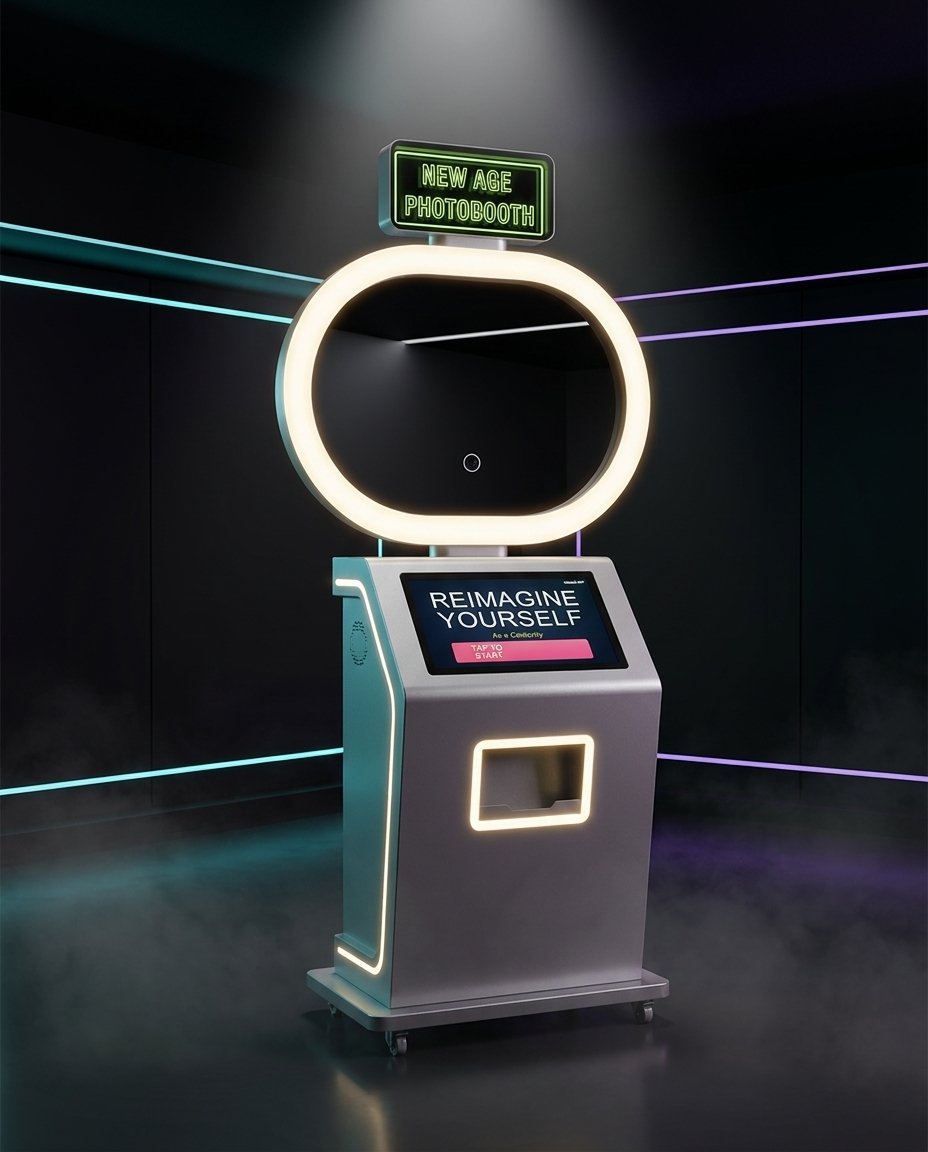
Importantly, virtual try-on is not just an e-commerce feature. In-store deployments — kiosks, smart mirrors, and interactive screens placed inside retail stores — are a rapidly growing segment. These allow customers to browse and "try" garments without waiting for a fitting room, without needing every size and colour in stock, and without the physical effort of changing clothes repeatedly.
The core promise is the same whether online or in-store: reduce the guesswork in buying clothes, speed up the selection process, and give customers more confidence in their purchase.
The Three Technology Approaches
Not all virtual try-on is built the same. There are three fundamentally different technical approaches, each with distinct strengths and limitations.
1. AR Overlay
The simplest approach. A 2D image of the garment is superimposed onto the customer's live camera feed in real time. The system tracks body position and scales the garment image accordingly. This is what most early "AR try-on" apps used — including many eyewear and accessory try-ons.
Pros: Fast, works on most devices, low processing requirements, real-time.
Cons: The garment looks flat, does not respond to body movement convincingly, cannot simulate fabric drape or fit. Best suited for accessories, eyewear, and simple tops rather than complex garments.
2. 3D Avatar
A more sophisticated approach where the system builds a 3D model of the customer's body — either from a body scan, measurements, or photographs — and then simulates the garment on that avatar using fabric physics. The garment stretches, drapes, and folds according to the body shape and the material's physical properties.
Pros: Most accurate for fit prediction, handles complex garments like sarees and gowns, shows how fabric actually behaves.
Cons: Requires 3D-digitised garments (expensive to produce at scale), computationally heavy, the avatar may look obviously synthetic rather than photorealistic.
3. Generative AI
The 2025–2026 wave. Instead of overlaying or simulating, a generative AI model takes a photo of the customer and a standard product photo of the garment, then generates a new, photorealistic image of the customer wearing that garment. The AI has been trained on vast datasets of how different fabrics behave on different body types, so it can produce realistic drape, fold, and stretch without any 3D scanning.
Pros: Works from standard product photography (no 3D digitisation needed), photorealistic output, scalable to massive catalogues quickly.
Cons: Not real-time (typically takes 10–20 seconds per generation), accuracy depends on the model's training, less precise for fit prediction than 3D avatar approaches. Google, ASOS, and OTB Group (Diesel, Maison Margiela) have all adopted this approach.
How the AI Behind It Works — Step by Step
Regardless of the specific approach, most modern virtual try-on systems follow a similar pipeline. Here is what happens when you select a garment to try on:
Step 1: Camera Capture
The system captures an image or video feed of the customer, either from a phone camera, a kiosk camera, or a smart mirror. Lighting normalisation and background segmentation may be applied.
Step 2: Pose Estimation
AI detects key body landmarks — shoulders, elbows, wrists, torso, waist, hips, knees, ankles — typically using models similar to Google's MediaPipe or OpenPose. This creates a "skeleton" map of the body's current position and proportions.
Step 3: Body Segmentation
The system identifies which pixels in the image belong to the body versus the background, and further segments body parts (arms, torso, legs). This is essential for determining where the garment should appear and what it should occlude.
Step 4: Garment Mapping
The selected garment is warped, deformed, or generated to match the body's proportions and pose. In AR overlay, this is a geometric transformation. In generative AI, this is where the model produces a new image, understanding — as Google's engineering blog describes it — "how different materials fold, stretch and drape on different bodies."
Step 5: Rendering
The final composite is displayed. For AR overlay, this happens in real time. For generative AI approaches, the result typically takes around 10–20 seconds to produce, though this is improving rapidly.
The quality difference between approaches is most visible in this final step. AR overlays look like stickers. 3D avatars look like video game characters. Generative AI, at its best, produces images that are nearly indistinguishable from an actual photograph of the person wearing the garment.
Who's Using It — Real Deployments
The following are verified virtual try-on deployments, each with a named source. We have deliberately excluded companies that merely announced pilots or partnerships without confirmed live rollouts.
Google Shopping
Google's virtual try-on uses a generative AI model that works from standard product photographs. The feature covers billions of product listings across tops, dresses, and bottoms, and is live for Indian users. Shoppers can see how garments look on AI-generated models of different body types, skin tones, and sizes before clicking through to purchase.
Source: Google Blog, "Virtual try-on with AI" (2024)
Aza Fashions (India)
In May 2026, Aza Fashions launched what it describes as India's first occasion-led virtual try-on experience. The platform covers over 50 Indian designers and more than 10,000 styles, targeting wedding and occasion shopping — a segment where physical try-on is particularly time-intensive.
Source: ANI News (May 2026)
Lenskart (India)
India's leading eyewear platform reports that one in four app users actively use its AR try-on feature. The company has seen 3x growth in AR try-on usage, making it one of the most successful virtual try-on implementations in the Indian market.
Source: IndiaAI (Government of India AI portal)
CaratLane / Tata (India)
CaratLane, the Tata-backed jewellery brand, introduced 3D virtual try-on for its jewellery catalogue. The company reported a 20% increase in conversion rates after implementing the feature.
Source: Indian Retailer
Walmart / Zeekit
Following its acquisition of Israeli startup Zeekit, Walmart rolled out virtual try-on covering over 270,000 items with its "Be Your Own Model" feature, allowing shoppers to upload their own photos or select models that resemble their body type.
Source: TechCrunch
Snap Inc. — AR Mirrors
Snap has deployed physical AR Mirrors — large interactive screens using its AR technology — inside Nike and Men's Wearhouse retail stores. These are in-store installations that let customers try on outfits virtually without entering a fitting room.
Source: MIT Technology Review
ASOS
ASOS launched virtual try-on in February 2026, starting with 10,000 products. The feature uses generative AI to show how garments look on different body types, and the company has indicated plans to scale across its full catalogue.
Source: The Interline (Feb 2026)
The Business Case — Verified Numbers
The commercial argument for virtual try-on rests on three pillars: higher conversion, lower returns, and stronger engagement. Below are the numbers we could verify with named sources.
| Metric | Finding | Source |
|---|---|---|
| Conversion uplift | 27% average increase for fashion brands using AR try-on | Shopify 2024 Merchant Survey |
| Return reduction | Up to 28% reduction (eyewear retailers) | Deloitte 2024 |
| Return reduction | 45% return reduction post-implementation | Warby Parker |
| Purchase confidence | 62% increase in purchase confidence | Nordstrom |
| Customer lifetime value | 19% higher LTV for VTO users over 12 months | Sephora |
| Click-through rate | 20% higher CTR for products with AR features | Amazon |
| Time on product | 25% increase in time spent on product pages with AR | Target |
The conversion and return numbers are particularly significant for Indian fashion retail, where return rates for online apparel purchases are notoriously high. Fit uncertainty is the primary driver of apparel returns, and virtual try-on directly addresses that uncertainty.
The engagement metrics matter too. When customers spend more time interacting with a product — rotating it, trying different colours, seeing it on their own body — they develop a stronger purchase intent and a more realistic expectation of the product. This leads to fewer "it looked different online" returns.
For in-store deployments, the business case shifts slightly. The value is not in reducing returns (customers can already see the product) but in expanding the number of options a customer considers per visit. A customer who might try five outfits in a fitting room might browse and virtually try thirty, significantly increasing the chance of a sale and the average order value.
The Indian Opportunity — Ethnic Wear and Wedding Shopping
India's fashion retail landscape has characteristics that make it particularly suited to virtual try-on, especially in ethnic and occasion wear.
Consider the wedding shopping experience. A bride-to-be or her family will visit multiple stores, often across cities, trying on dozens of lehengas, sarees, and suits. Each garment requires time to drape, pin, and adjust. A lehenga trial can take 15–20 minutes per outfit. Across a typical wedding shopping journey, a family might invest days in physical try-ons before making a selection. The process is exhausting, and it is difficult to compare outfits seen across different stores and different days.
Virtual try-on can dramatically compress the shortlisting phase. A customer could virtually try 30 lehengas in the time it takes to physically try three, then focus physical try-ons only on the top candidates. This does not replace the final fitting — no one is buying a wedding lehenga without touching the fabric — but it transforms the discovery and shortlisting process.
Aza Fashions has clearly identified this opportunity, positioning its VTO launch explicitly around wedding and occasion shopping. The platform covers 50+ designers and 10,000+ styles — a scale that would be impossible to browse physically in any single store visit.
The opportunity extends beyond weddings. Sarees, sherwanis, kurta sets, and other ethnic garments share the same friction: they are time-consuming to try on and difficult to visualise from a flat product photo. A saree on a hanger looks nothing like a saree draped on a body. Virtual try-on bridges that gap.
For multi-brand ethnic wear stores, wedding boutiques, and designers with physical retail presence, in-store VTO kiosks offer a way to showcase a far larger catalogue than floor space allows — effectively giving a 500 sq ft store the browsing range of a 5,000 sq ft one.
What's Coming Next
The biggest shift underway is that generative AI is making garment digitisation near-free. Historically, creating a 3D model of a garment for virtual try-on required specialised photography, 3D scanning, or manual modelling — costing anywhere from $50 to $500 per garment. Generative AI models can now work from a single standard product photograph, making it feasible to enable virtual try-on across entire catalogues without any special asset creation.
Google Cloud has made its virtual try-on capabilities available as an API for brands and retailers to integrate into their own platforms. Body scanning from phone photographs — using just two or three photos to generate accurate body measurements — is improving rapidly, which will make fit prediction more precise without requiring any hardware beyond a smartphone.
In-store virtual try-on is moving from experimental to standard. As kiosk hardware becomes more capable and AI inference moves to edge devices, the latency and cost of in-store VTO are dropping. The next two to three years will likely see virtual try-on kiosks and smart mirrors become as commonplace in fashion retail as digital signage is today.
Exploring Virtual Try-On for Your Store?
Bamigos.com is an Indian manufacturer of AI-powered kiosks and interactive technology. We are working on virtual try-on solutions for retail stores. If you are a clothing brand exploring this technology, talk to us.