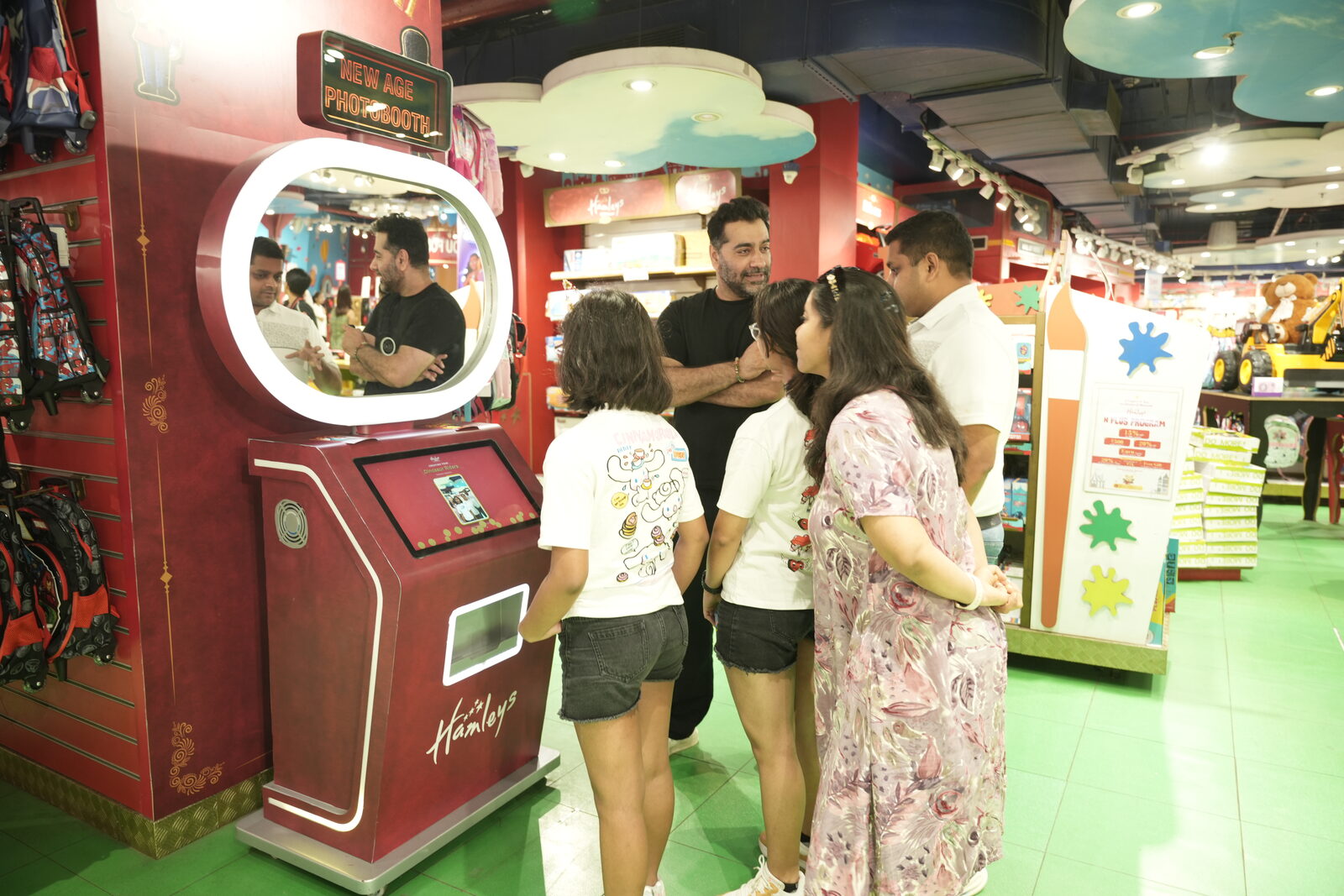
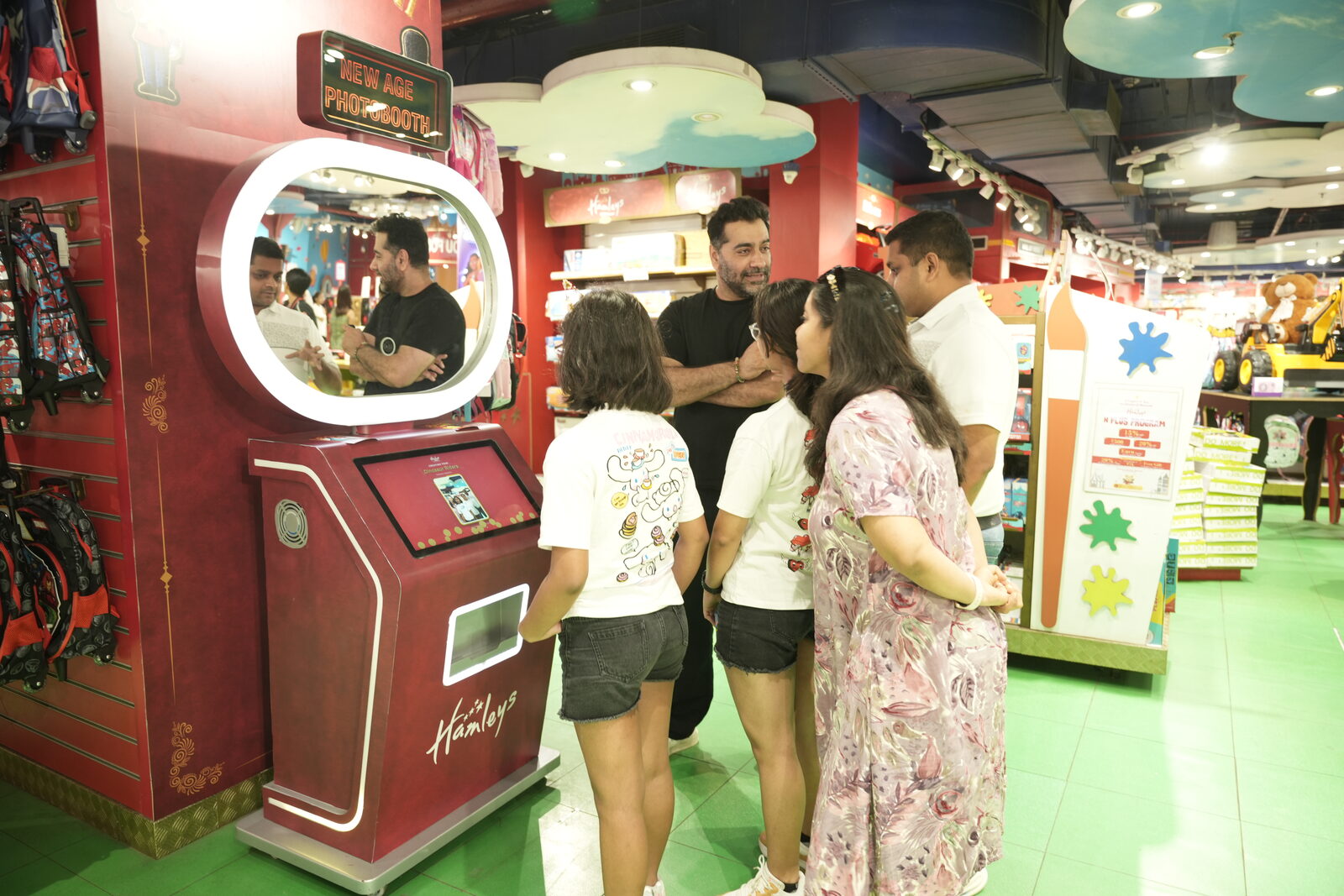
Walk past the school bags and the air hockey tables in a Hamleys store in Delhi NCR and you'll hit a queue that has nothing to do with toys. The Hamleys photo booth is a deep red cabinet with gold trim, built to match the rest of the store. There's a toy soldier painted on one side, the famous guardsman bear on the other, and a glowing oval mirror in the middle. The sign above it says "New Age Photobooth."
It takes up 6.3 square feet. On a busy weekend, that might be the hardest working 6.3 square feet in the store.
Who uses the Hamleys photo booth
We assumed kids. We were half right.
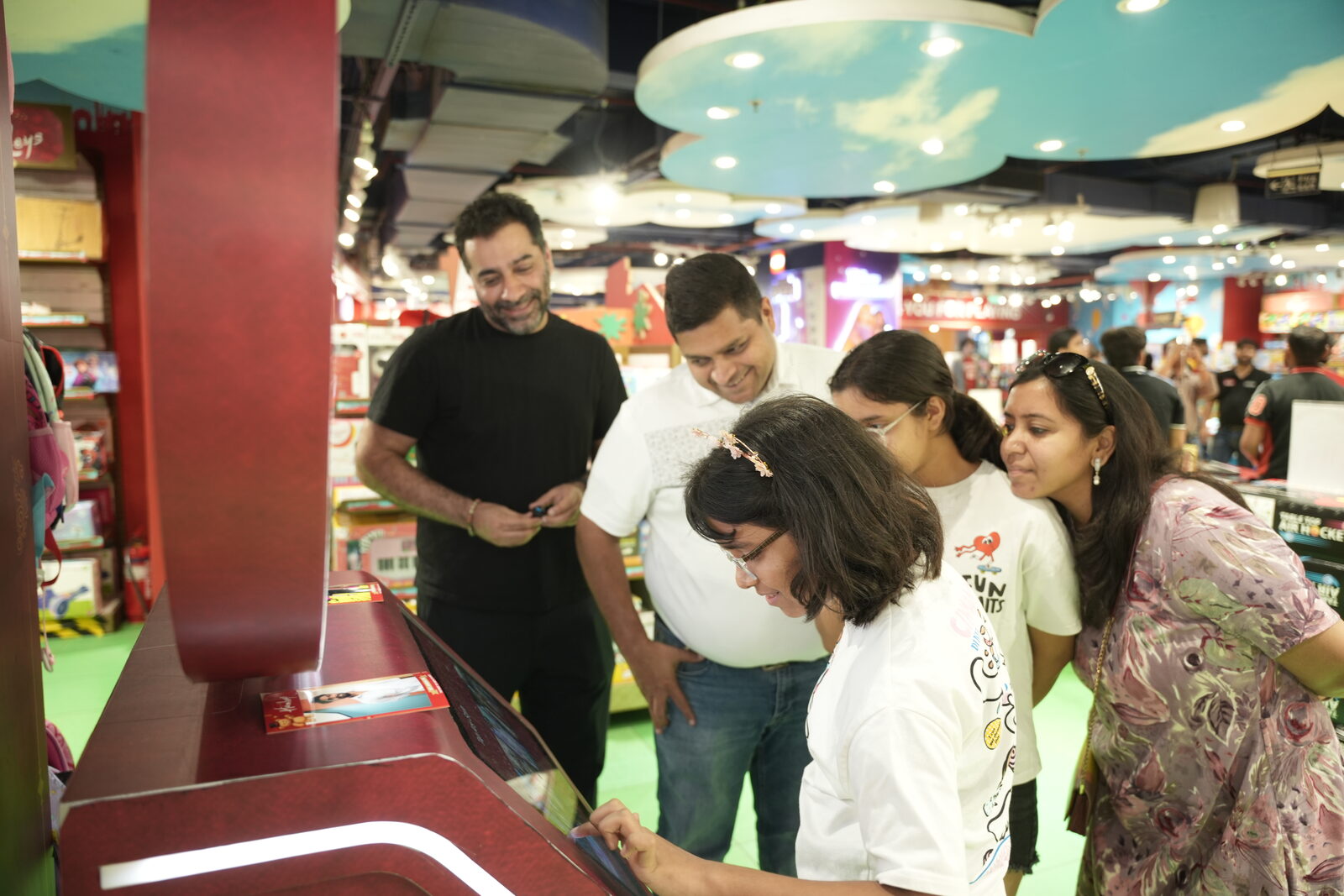
Families come as a unit. Dad, mom, two daughters, everyone crowding the touchscreen at once and arguing about which style to pick. The booth shoots them together, which almost never happens otherwise. In every other family photo, one parent is missing because they're holding the phone.
Father and daughter, father and son duos are the surprise regulars. A dad who has been trailing his kid through the store for forty minutes suddenly has a two minute activity that belongs to both of them. They pose, they laugh at the AI styles, and they walk out with a print each.
Then there are the teenagers. Groups of girls who treat it like a K-pop photo studio and know exactly what they want before the countdown starts. They've seen the format on Instagram. Now it's in front of them, and it prints.
The reaction when the photos appear on screen is the part no spec sheet captures. Kids jump. Actually jump. Then everyone leans in to see themselves in two hundred plus AI styles, and the debate over which one to print starts all over again.
Customers reacting to their AI photos at the Hamleys photo booth.
The print is the point
Every session ends with a physical 4x6 print, and every print carries the Hamleys branding.
Think about what that object does. A phone photo gets buried under four hundred others by Sunday night. A print goes on the fridge, the study desk, the office cubicle. It might be the only photograph that family took together that month, and Hamleys is on it, permanently, in the corner of a happy memory.
Consumer psychologists have a name for this: brand attachment, the emotional bond that forms when a brand gets woven into a person's memories and sense of self. It's a formal, measured construct (Park, MacInnis and colleagues defined it in the Journal of Marketing back in 2010), and the research is blunt about what builds it. Not ad exposure. Shared experiences. Hamleys didn't advertise at this family. It took part in a memory and then let them carry the evidence home.
There's a second mechanism at work too. Daniel Kahneman's peak-end rule says people judge an experience by its most intense moment and by how it ends, not by the average of the whole visit. The booth delivers both. The peak is the moment the AI photos appear and the kids jump. The end is walking out of the store holding a print. A family can spend an hour inside, but the two moments memory keeps are the ones with Hamleys printed on them.
The loop doesn't stop at the fridge either. The same photos go straight to Instagram. Teens post the prints, parents post the kids, and each post is a geotagged endorsement written by the customer, for free, to an audience that trusts them more than any ad.
A branded photo booth for retail stores
Starting a Photo Booth Business?
Get AI photo booth pricing and ROI details from our team. No obligation.
Retail floor space is measured, fought over, and rented by the square foot. Here's what this particular 6.3 sq ft does that a shelf can't:
- It holds people in the store longer. A queue at a photo booth is dwell time, and dwell time is the retail metric everything else follows.
- It gives kids a reason to come back. Nobody asks to return to a store for the shelves.
- It earns per-session revenue while doing all of the above. The booth is a paid attraction, not a cost centre.
- It manufactures user-generated marketing one Instagram story at a time, at a rate no brand campaign can match.
The machine behind it
The booth in these photos is a Pikcha AI photo booth. Pikcha is designed and manufactured in New Delhi by Bamigos, an Indian company that has been building experience machines since 2022. Every Pikcha gets new AI effects over the air, prints on a Japanese DNP dye-sublimation printer, monitors its own paper and connectivity, and reports to a fleet dashboard so an operator can run several booths without standing next to any of them. Pikcha machines start at ₹3.5 lakh, and each one is custom branded to its venue: the cabinet skin, the on-screen journey, and the print layouts. The Hamleys unit wears Hamleys livery. The same machine runs in malls, arcades, and family entertainment centres across India, each wearing its operator's identity.
The short version
Put a photo booth where families already are, brand it properly, and give people a print to carry home. The families get a memory. The store gets dwell time, repeat visits, session revenue, and a fridge-door ad campaign it never has to renew.
Six point three square feet. That's all it takes.
Hamleys photo booth: quick answers
Where is the Hamleys photo booth?
Inside select Hamleys stores in Delhi NCR. Look for the red and gold booth with the glowing mirror. New locations are added through the year.
How does the Hamleys photo booth work?
Stand in front of the mirror, pick from 200+ AI photo styles on the touchscreen, pose, and collect your branded 4x6 print in seconds. The photos also arrive on your phone, ready to post.
Who makes the Hamleys photo booth?
It's a Pikcha AI photo booth, made in New Delhi by Bamigos. Bamigos manufactures AI photo booths and other experience machines for malls, retail stores, arcades, and family entertainment centres across India.
Can my store get a photo booth like the one at Hamleys?
Yes. Every Pikcha is custom branded to the venue, from the cabinet skin to the print layouts. Photo booth machines start at ₹3.5 lakh, and rental programs are available for shorter activations.
How much space does a photo booth need?
The Pikcha booth at Hamleys uses just 6.3 sq ft of floor space, roughly the footprint of a mannequin, plus a standard power socket and an internet connection.
Pikcha AI photo booths are designed and manufactured in India by Bamigos. Machines start at ₹3.5 lakh with full branding customisation for retail and entertainment venues. Talk to us about putting one in your store.